
























Private Label vs OEM Coffee Capsules: What’s the Practical Difference
A buyer says they need private label coffee capsules. Another asks for OEM. A third uses both terms in the same email to describe exactly

“Keep three months of stock.”
It sounds sensible. It’s also the kind of inventory advice that can be completely right for one coffee business and completely wrong for another.
A distributor importing capsules by sea doesn’t face the same replenishment risk as a roaster buying standard capsules locally. A fast-growing SKU shouldn’t necessarily carry the same inventory coverage as one with predictable monthly demand. And a custom-printed capsule becomes much harder to reuse if the product, artwork or brand strategy changes.

That’s why there isn’t one “correct” number of coffee capsules a buyer should keep in stock.
A better approach is to work backwards from the business.
How quickly are capsules actually consumed? How long does replenishment really take—not just production, but transportation and receiving as well? How much does demand move from month to month? And what would happen operationally if one SKU ran out?
For buyers using wholesale and bulk coffee capsule supply, inventory is ultimately a balance between two costs:
having too much,
and not having enough.
Knowing that you have 100,000 capsules in stock isn’t particularly useful on its own.
The same inventory can represent ten months of supply for one business and two months for another.
A better starting measure is inventory coverage.
In simplified form:
Inventory coverage = usable inventory ÷ average consumption per period
If a business has 60,000 usable capsules and consumes approximately 20,000 per month, it has around three months of inventory coverage.
The word “usable” matters.
Don’t count damaged stock. Don’t count capsules reserved for another customer or production program if they aren’t actually available. And be careful combining different SKUs into one inventory number.
50,000 black capsules don’t solve a shortage of gold capsules if the two belong to different products.
Historical usage is usually the best starting point for an established SKU. Rather than taking one unusually strong or weak month, look at several periods and understand why consumption changed.
For a new product, the estimate will be less certain. That’s normal.
In that situation, a range is often more useful than a precise-looking forecast.

This is one of the easiest inventory planning mistakes to make.
A supplier says production takes a certain number of days, so the buyer uses that number as the replenishment time.
But inventory doesn’t become usable when production finishes.
Depending on the order and sourcing route, there may still be:
Some stages can overlap, and the actual timing varies considerably between markets and shipping methods.
The point isn’t to add an arbitrary buffer to every order.
It’s to measure the complete period from “we need to reorder” to “this stock is available for use.”
For overseas procurement, international coffee capsule shipping therefore belongs inside the inventory calculation.
Not after it.
Once consumption and replenishment time are understood, buyers can begin thinking about a reorder point.
A simplified model is:
Reorder point = expected demand during replenishment + safety stock
Suppose a SKU consumes approximately 25,000 capsules per month and the full replenishment cycle is expected to take two months.
Expected consumption during that period would be approximately 50,000 capsules.
If the business decides it also needs an additional buffer for demand or supply uncertainty, that buffer sits on top of the 50,000.
These numbers are examples, not recommendations.
The principle is what matters.
If you wait until inventory drops to zero before ordering, the purchase order is already too late.
The reorder point exists to trigger purchasing while enough stock remains to cover the period before the replacement shipment arrives.
Many companies inherit a safety-stock rule.
“Always keep one extra month.”
“Keep 20%.”
“Never drop below 50,000 pieces.”
Those rules may have made sense when they were created. They may also have outlived the conditions behind them.
A more useful safety-stock discussion looks at two sources of uncertainty:
Demand variability.
And replenishment variability.
If monthly sales are highly predictable and the supply route is stable, the business may need less buffer.
If demand can rise suddenly, the capsule is customized, and replenishment involves international transportation, the consequences of holding too little stock may be much greater.
Then consider the business impact of a stockout.
Would production stop?
Would a retailer order be missed?
Can another capsule SKU temporarily substitute?
Is the capsule branded so specifically that excess stock would also be costly?
Safety stock is where commercial risk tolerance enters the inventory calculation.
There isn’t one percentage that answers those questions for every buyer.
Average consumption is useful until the business enters a month that isn’t average.
Coffee products can experience seasonal demand, retail promotions, holiday activity, new product launches or distributor stocking cycles.
If a buyer uses a simple twelve-month average without looking at when demand occurs, inventory can appear healthy right before a predictable peak.
For example, annual consumption may average 30,000 capsules per month.
But if several months run closer to 20,000 while a promotional period reaches 60,000, planning every month around the 30,000 average creates obvious risk.
Again, the figures are only examples.
The point is to retain the time pattern in demand.
Before a known seasonal period, ask:
What happened during the equivalent period last year?
Has the customer base grown since then?
Is a promotion confirmed or only possible?
Does the supplier need advance notice for higher volume?
Will shipping capacity become more difficult during the same period?
Averages simplify data.
Inventory planning still needs the story behind the average.
A warehouse can contain plenty of capsules and still have a serious stock problem.
The wrong SKU is in stock.
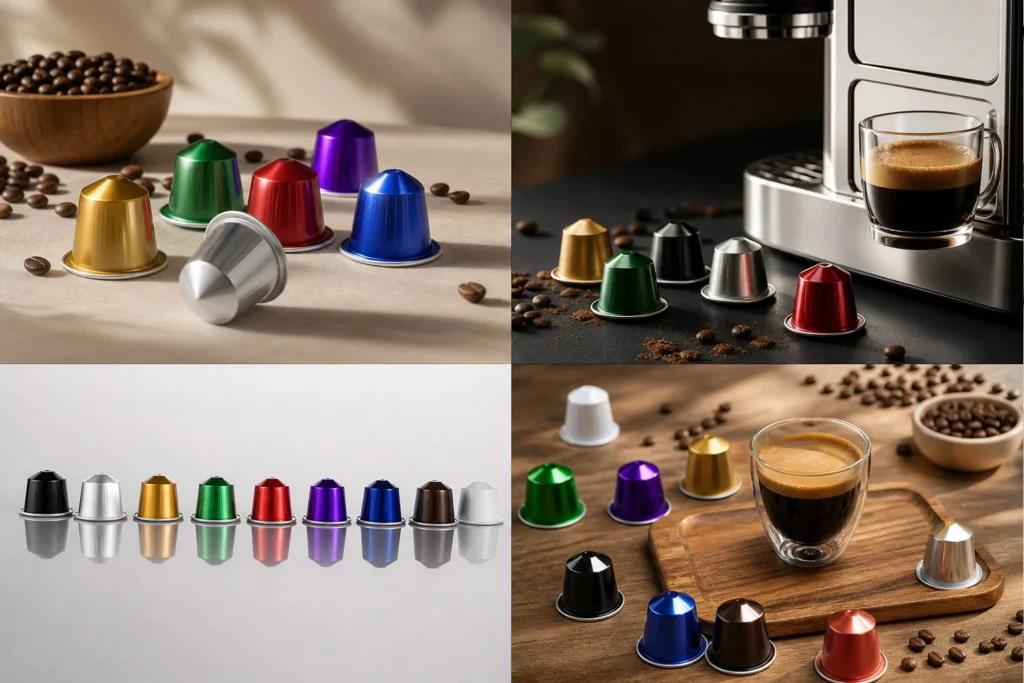
Suppose a brand carries four capsule colors:
If Espresso accounts for half of sales while Single Origin represents a much smaller share, equal inventory across all four products is unlikely to make sense.
Each SKU should have its own:
Customization makes this more important.
A generic standard capsule may be useful across several products.
A custom-colored or logo-printed capsule is tied much more closely to one SKU or brand identity.
If that SKU is discontinued, changed or redesigned, remaining capsule stock may lose much of its practical value.
This is why inventory planning becomes more important—not less—when a coffee brand adds more product choices.
There is a meaningful difference between having too many standard capsules and having too many fully customized ones.
Standard stock is generally more flexible.
Custom inventory can carry:
That means excess custom inventory has fewer alternative uses.
This doesn’t make customization a bad decision. For established products with predictable demand, custom capsules can be entirely appropriate.
It simply means purchasing quantities should match demand confidence.
For a new or uncertain product, low-MOQ coffee capsule purchasing can sometimes reduce early inventory exposure while the business learns actual market demand.
As the SKU becomes more predictable, the economics may move in the other direction. Larger production runs can reduce unit cost and simplify replenishment.
The right inventory strategy can therefore change as the product matures.

International freight introduces a trade-off.
Ordering more frequently can reduce inventory levels.
But each shipment carries its own transportation and handling costs.
Ordering larger quantities may improve freight efficiency, but it also places more stock and cash into the warehouse at once.
There isn’t a universal answer because shipping economics depend on destination, carton dimensions, transport mode, pallet requirements and current freight conditions.
For empty capsules, volume is particularly relevant because the product is lightweight relative to the space it occupies.
A useful purchasing comparison therefore looks at several scenarios.
Například:
Smaller order + more frequent freight
versus
larger order + less frequent freight
Then compare total cost, inventory coverage and stockout risk.
At Kervoo, standard aluminum capsules are packed 4,000 pieces per carton. Buyers can use confirmed carton and freight information to model different order sizes rather than assuming that either “more shipments” or “bigger shipments” will always be cheaper.
A good inventory plan shouldn’t require perfect forecasts.
It should give the business time to react when forecasts are wrong.
That means sharing useful forward information before the purchase order becomes urgent.
Například:
“We expect normal demand next quarter.”
“We’re adding a second SKU.”
“A retail promotion may double demand in November.”
“Our current inventory should last approximately ten weeks.”
Information like this helps both sides prepare.
For businesses using stable coffee capsule supply programs, a rolling view of demand can be more useful than a single annual forecast that is never updated.
The buyer gets more visibility into stock risk.
The manufacturer gets more time to plan production.
Neither side needs perfect information.
They need enough information early enough to make a decision.
Urgent orders often begin much earlier than the email marked “URGENT.”
They begin when a fast-selling SKU wasn’t separated from total inventory.
Or when production lead time was used instead of full replenishment time.
Or when a promotion increased demand but the purchasing plan wasn’t updated.
By the time everyone realizes there’s a problem, the available options are already narrower.
After more than 10 years manufacturing aluminum coffee capsules, we’ve found that buyers with smoother replenishment usually don’t have dramatically more sophisticated systems.
They simply know a few things reasonably well:
how quickly each important SKU is being consumed,
roughly how much usable stock remains,
when the next order needs to be available,
and what demand changes are coming.
Those four pieces of information solve a surprising number of inventory problems before they become urgent.
For buyers who want a simple starting point, the process can be kept manageable.
First, calculate average consumption separately for each meaningful SKU.
Then determine the full replenishment period from placing the order until the capsules are actually available for use.
Estimate how much will be consumed during that period.
Add safety stock based on demand and supply uncertainty.
Then compare the result with current usable inventory.
In simplified terms:
Target inventory need =
expected demand during replenishment
Reorder requirement =
target inventory need
− usable inventory expected to remain
After that, adjust for:
Minimální objednávka
carton quantities
seasonality
confirmed promotions
freight economics
and any known production constraints.
The calculation doesn’t need to predict the future perfectly.
Its job is to make the assumptions visible.
Once the assumptions are visible, buyers can challenge them—and update the plan before the warehouse reaches zero.
Často kladené otázky
How many months of coffee capsule inventory should I keep?
There is no universal number. Appropriate inventory coverage depends on consumption, demand variability, replenishment time, shipping risk, SKU characteristics and the business impact of a stockout. A fixed “three-month rule” may be appropriate for some buyers and inefficient for others.
How do I calculate a reorder point for coffee capsules?
A simple starting model is expected demand during the full replenishment period plus safety stock. The most important part is using realistic replenishment time that includes production and logistics rather than factory lead time alone.
How much safety stock should I hold?
Safety stock should reflect uncertainty in demand and supply as well as the commercial consequences of running out. There is no universally correct percentage.
Should custom coffee capsules have more or less inventory?
That depends on demand certainty and replenishment risk. Custom capsules can be harder to reuse if a SKU changes, making excess inventory more costly. At the same time, long replenishment periods may justify a larger buffer for stable, high-volume products.
Should I manage coffee capsule inventory by total quantity or by SKU?
By SKU wherever the products aren’t interchangeable. Total inventory can hide shortages in fast-moving colors or products while slower SKUs remain overstocked.

Specialista na výrobu kávových kapslí · Kervoo
Od roku 2024
A buyer says they need private label coffee capsules. Another asks for OEM. A third uses both terms in the same email to describe exactly

A perfect sample is reassuring. It looks right. The color is right. It drops into the machine smoothly and brews without leaking. Put ten more

Dobrá prezentace ještě neznamená, že se jedná o přesvědčivé důkazy. Webové stránky dodavatele, katalog a prodejní prezentace jsou užitečným výchozím bodem. Mohou vám poskytnout informace o