

























What Evidence Matters More Than a Supplier’s Sales Presentation?
A Good Presentation Is Not the Same as Good Evidence. A supplier’s website, catalog and sales presentation are useful starting points. They can tell you

An aluminum coffee capsule can leave the factory looking perfectly fine and arrive at the destination with a different problem: a few rims are bent, dented or no longer as clean and even as they were before shipment.
This can be frustrating, especially when the capsules passed production inspection.
But transportation is another part of the product’s life.
Once the cartons leave the factory, the capsules may experience stacking, vibration, impacts, loading and unloading, warehouse handling and changes in how the cartons are positioned. If the packaging does not provide enough support, the capsule rim can become the part that takes the load.
This matters because the rim is not just a cosmetic feature. Depending on the capsule and filling system, rim condition can also affect lid positioning, sealing and the way the capsule is handled by downstream equipment.

Transport packaging therefore needs to protect the capsule as a product, not simply make it possible to put more pieces into one carton.
Aluminum is widely used for coffee capsules because it combines low weight, formability and useful barrier properties.
But the same lightweight construction means that thin formed aluminum components can be sensitive to localized mechanical loads.
The important distinction is between overall carton strength and local protection.
A carton may remain intact while some capsules inside have damaged rims.
For example, if the internal arrangement allows the upper carton layer to press directly onto the rims of capsules below, the outer carton can look completely normal while the capsules underneath experience concentrated pressure.
This is why a transport problem should not automatically be diagnosed as “the aluminum is too weak.”
The actual question is:
Where did the force go?
If the load is distributed through suitable packaging surfaces, the capsule may travel without significant deformation. If the load is transferred through a relatively small contact area around the rim, localized damage becomes more likely.
This is also why changing the carton alone does not always solve the problem. The internal arrangement, separators, quantity per layer and how the capsules are supported can be just as important.
One of the most common risks in bulk transportation is stacking.
Cartons rarely travel completely by themselves. They may be stacked in a warehouse, on a pallet, inside a truck or container, and sometimes temporarily stacked during loading or unloading.
The important question is not simply how many cartons are stacked.
It is whether the lower cartons are designed to carry the resulting load without transferring excessive force to the capsules inside.
Suppose a carton contains hundreds or thousands of empty aluminum capsules. If the internal structure does not distribute the load properly, the weight from cartons above can gradually become a localized force on the capsule layers below.

This is particularly worth checking when:
ISTA specifically treats compression, shock and vibration as different transport hazards rather than treating transportation damage as one single problem. Its guidance also emphasizes understanding how packages are actually stored, handled and transported when selecting a test method.
Impact is easy to imagine.
Vibration is less obvious.
During road, rail or other transportation, cartons can experience repeated vibration. Over a long journey, small movements inside the carton can become important.
If the capsules are packed too loosely, they may move, rotate or shift position repeatedly.
That creates two possible problems.
First, capsules can rub against each other or against the internal packaging.
Second, the original load distribution can change.
A carton that was perfectly arranged when it left the factory may no longer have the same internal arrangement after days of vibration.
ISTA’s transport-testing guidance distinguishes random vibration from simpler fixed-displacement vibration because real transport environments are more complex than a single repetitive movement. (Support Center)
For a coffee capsule shipment, the practical lesson is simple:
The packaging should control movement, not just hold the capsules.
The right amount of internal restraint depends on the capsule geometry, quantity, carton dimensions and transportation route. Packing everything as tightly as possible is not automatically better either. Excessive pressure can create another source of damage.
Not every damaged capsule comes from long-term compression.
A single handling event can be enough.
A carton can be dropped, tilted, dragged or hit against another package during loading or unloading. The resulting impact can temporarily create a much higher force than the capsule normally experiences while sitting in storage.
The damage may be concentrated in one part of the carton.
That is why buyers sometimes find that only a small percentage of capsules are visibly damaged after arrival.
The problem may not be uniform packaging pressure. It may be an impact event affecting one corner, one side or one layer.
ISO 2248 describes a standardized vertical drop-impact test for complete, filled transport packages. The test uses predetermined conditions such as drop height and package orientation to evaluate the effect of impact. (ISO)
This does not mean every coffee capsule shipment needs to be tested according to ISO 2248.
It does mean that drop and impact are recognized packaging hazards, and transport packaging should be evaluated with the actual distribution environment in mind.
When capsule damage occurs, buyers often look at the aluminum capsule first.
The carton should be investigated at the same time.
Look at:
A small difference in carton geometry can change how the load is transferred.
For example, if a carton is slightly too tall, the lid or upper packaging layer may not provide enough support. If it is too short, the contents may be compressed before the carton is even closed properly.
The objective is not to create the strongest possible carton.
It is to create a packaging system where the carton, internal protection and capsule arrangement work together.
For bulk empty capsule supply, quantity per carton matters.
KERVOO commonly packs 4,000 empty aluminum coffee capsules per carton for applicable stock products.
That number is useful for logistics planning, but it should not be interpreted as a universal rule that every capsule type must always use exactly 4,000 pieces per carton.
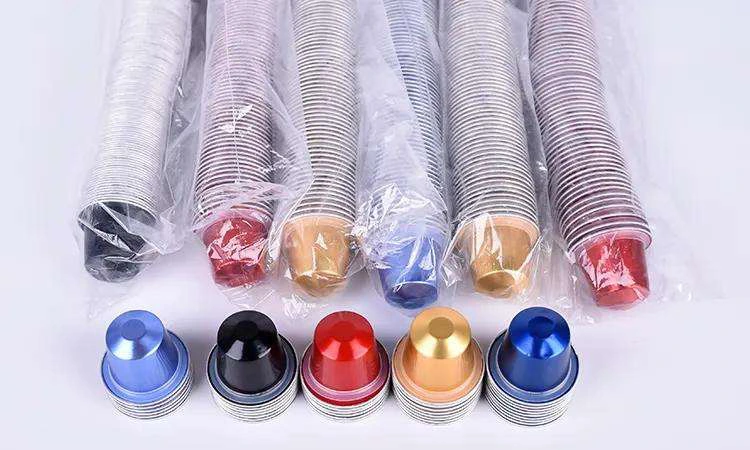
The actual packing configuration depends on capsule geometry, carton dimensions, internal protection and shipping requirements.
For a buyer, the useful questions are:
How many capsules are in each carton?
How are they arranged?
Are there internal separators or protective structures?
Can the capsules move significantly during transport?
How many cartons are stacked on one pallet?
How is the pallet secured?
These questions become especially important when moving from samples to commercial quantities.
A packing configuration that works for a small sample shipment may not necessarily be the best configuration for a palletized bulk order.
A carton can be well designed and still experience problems because of palletization.
If cartons are not aligned properly, part of the load may sit on unsupported areas. If the pallet is uneven, the cartons may deform. If stretch wrapping is too loose, the load can shift. If it is too tight, excessive compression can be introduced.
The pallet should therefore be considered as another layer of the packaging system.
For large orders, buyers should confirm:
This becomes particularly important for long-distance international shipments where the cargo may be handled multiple times before reaching the final warehouse.
A shipment that looks stable inside the factory may experience several different handling environments before delivery.
When a buyer discovers damaged rims, the first reaction may be to reject the whole shipment.
That may be appropriate in some situations, but it is better to quantify the problem first.
Record:
The distribution pattern can provide useful clues.
If damage is concentrated in the top layer of one carton, the issue may be local compression or internal packing.
If the same area of multiple cartons is damaged, pallet stacking or handling may be involved.
If damage appears randomly across the shipment, vibration or repeated handling may be worth investigating.
The goal is to find the failure pattern before deciding on the corrective action.
If a shipment arrives with damaged capsule rims, send the manufacturer more than a single photo.
A useful transport-damage report should include:
Order information: PO number, production batch and shipping date.
Quantity: Total quantity received and estimated quantity affected.
Carton information: Which carton numbers are affected.
Photos: Overall carton condition, pallet condition, inner packing and close-up images of the damaged capsules.
Damage location: Top, bottom, edge, center or a specific layer.
Shipping information: Air, sea, truck or courier; approximate transit time; whether transshipment occurred.
Handling evidence: Visible carton crushing, puncture, water damage, broken pallet or shifted cartons.
Functional result: Whether the capsules can still be filled, sealed and used normally.
ISTA recommends documenting test and distribution-related results, with photos, videos and drawings being useful documentation tools.
The same principle is useful when investigating an actual commercial shipment.
The best time to solve a transportation problem is before the goods leave the factory.
For larger or repeated orders, buyers can work with the supplier to review:
Packing quantity — Is the number per carton appropriate for the capsule?
Internal protection — Are the capsules adequately supported?
Carton strength — Can the carton withstand the planned stacking conditions?
Palletization — Is the load stable and evenly supported?
Shipping route — Is the packaging suitable for the expected handling environment?
Inspection — Are cartons and capsules checked before shipment?
For new packaging configurations, transport testing can also be considered.
ISTA’s procedures range from basic integrity tests to more realistic general-simulation tests. Its 3-Series procedures are designed to simulate damage-producing motions, forces, conditions and sequences found in transport environments.
There is a temptation to solve transport damage by simply adding more packaging.
More cardboard.
More separators.
More wrapping.
More compression.
But more material does not automatically mean better protection.
Additional packaging can increase:
It can also create excessive pressure if poorly designed.
The better approach is to identify how the capsule is being damaged and then add protection where it is actually needed.

If movement is the problem, improve internal restraint.
If stacking pressure is the problem, improve load distribution.
If corner impacts are the problem, improve carton and pallet protection.
If the problem occurs only on a specific shipping route, investigate that route rather than redesigning the entire package immediately.
Good transport packaging is not necessarily the package with the most material.
Before approving a large shipment, buyers can use this quick checklist:
| Item | What to Confirm |
|---|---|
| Capsule | Dimensions and rim condition meet specification |
| Quantity | Correct quantity per carton |
| Internal packing | Capsules are supported and controlled |
| Carton | Suitable size and strength |
| Pallet | Stable arrangement and secure wrapping |
| Stacking | Planned stacking height is reasonable |
| Inspection | Pre-shipment inspection completed |
| Photos | Packing condition documented |
| Shipping | Route and handling method confirmed |
| Damage criteria | Acceptable condition agreed in advance |
This does not need to become a complicated engineering exercise for every order.
For standard repeat shipments, a stable packing specification and consistent inspection process may be enough.
A damaged coffee capsule rim is rarely explained by one simple factor.
The real cause may involve the capsule geometry, internal packing, carton design, palletization, stacking pressure, vibration, impact or handling.
That is why transport damage should be investigated as a packaging-system problem, not simply as a product defect.
For buyers, the practical sequence is straightforward:
Check the damage pattern → identify where the force came from → review the internal packing → review carton and palletization → verify the shipping route → test the revised packaging if necessary.
For suppliers, the goal is equally straightforward: the packaging specification should be repeatable, documented and appropriate for the way the goods are actually shipped.
Frequently Asked Questions
Can aluminum coffee capsule rims be damaged during shipping?
Yes. Compression, impact, vibration, stacking and handling can all contribute to physical damage. The likelihood depends on the capsule structure and the effectiveness of the transport packaging.
Why are capsule rims more vulnerable than the middle of the capsule?
The rim is a functional edge that may have relatively limited support depending on how capsules are arranged. If loads are transferred through this area, localized deformation can occur.
Can better cartons prevent coffee capsule damage?
Better carton design can reduce risk, but the carton is only one part of the system. Internal arrangement, palletization, stacking and handling also matter.
Should buyers request transport testing?
For new or higher-risk packaging configurations, transport testing can be useful. The appropriate test should reflect the actual distribution environment and shipping method.
What should I do if capsules arrive with damaged rims?
Record the affected quantity, carton numbers, pallet location, photos, shipping information and functional impact. Send this information to the supplier so the damage pattern can be investigated.
Authoritative Sources & Further Reading

Coffee Capsule Manufacturing Specialist · Kervoo
Since 2024
A Good Presentation Is Not the Same as Good Evidence. A supplier’s website, catalog and sales presentation are useful starting points. They can tell you

For a coffee brand with only one product, capsule color is mostly a branding decision. Once the product range grows to several SKUs, however, color
An aluminum coffee capsule can leave the factory looking perfectly fine and arrive at the destination with a different problem: a few rims are bent,