

























What Evidence Matters More Than a Supplier’s Sales Presentation?
A Good Presentation Is Not the Same as Good Evidence. A supplier’s website, catalog and sales presentation are useful starting points. They can tell you
A Good Presentation Is Not the Same as Good Evidence. A supplier’s website, catalog and sales presentation are useful starting points.
They can tell you what the supplier claims to offer:
But these are claims, not necessarily verification.
For a buyer sourcing empty aluminum coffee capsules, the more important question is:
Can the supplier provide evidence that supports the claims?
There is a significant difference between:
“We can produce this.”
and
“Here is the specification, sample, test result, production evidence and QC record showing how we produce it.”
The second one gives a buyer something that can actually be evaluated.
A practical supplier verification hierarchy is:
Sales Presentation → Specifications → Samples → Testing → Production Evidence → QC → Traceability
The further down this list you go, the closer you get to evidence of actual manufacturing capability.

The first piece of evidence should be a clear specification.
For an empty aluminum coffee capsule, this may include:
The specification should be specific enough that two parties can determine whether the same product was supplied.
This is much more useful than descriptions such as:
“High quality aluminum capsule”
or
“Premium capsule with excellent compatibility.”
Those phrases sound positive but are difficult to measure.
A useful specification turns a marketing statement into something that can be checked.
A product image can show color and general appearance.
A physical sample can reveal much more.
For example, buyers can inspect:
If the capsule will eventually run through an automated filling line, the physical sample also allows the buyer to perform equipment testing.
This is important because an attractive sample is not automatically a production-ready sample.
A sample should be treated as a test object, not merely a sales gift.
Record the sample model, quantity, date and specification so that the results can later be compared with the production order.

Certificates are often displayed prominently in supplier presentations.
But buyers should look beyond certificate logos.
Ask:
What does the document actually cover?
For example:
This distinction matters particularly for food-contact applications.
A supplier may hold several certifications, but that does not automatically mean every capsule configuration has been independently tested against every requirement in the buyer’s destination market.
The buyer should therefore connect:
Product → Material → Test → Standard → Market
rather than simply collecting certificate images.
“Annual capacity: 100 million pieces.”
A number like this sounds impressive.
But annual capacity alone tells a buyer relatively little.
A better assessment asks:
For example, Kervoo’s reported annual production exceeds 100 million empty aluminum coffee capsules.
But the more useful verification is not the number itself.
It is whether the manufacturer can demonstrate actual production equipment, production processes, output and QC systems behind that number.
This is why a factory video, production-floor evidence or an on-site audit can be much more informative than a capacity figure on a brochure.
A supplier may say:
“We have strict quality control.”
The buyer should ask:
What exactly is being checked?
For empty aluminum coffee capsules, a practical QC system may include:
Incoming Material
In-Process Inspection
Final Inspection
The exact inspection plan depends on the product.
What matters is whether the supplier can explain what is checked, when it is checked, how it is recorded and what happens when a result falls outside the specification.
That is much stronger evidence than simply saying:
“Our QC is very strict.”
No manufacturing process is completely immune to defects.
The real test of a supplier is often what happens after an abnormality is discovered.
A useful traceability system should allow the supplier to connect a shipment or production batch with relevant information such as:
Suppose a buyer discovers an unusual number of damaged capsule rims.
Without traceability, the investigation may become:
“Something seems wrong with this shipment.”
With traceability, the question can become:
“Which batch was affected, when was it produced, which line produced it, and what inspection records are associated with it?”
That difference can significantly reduce investigation time.
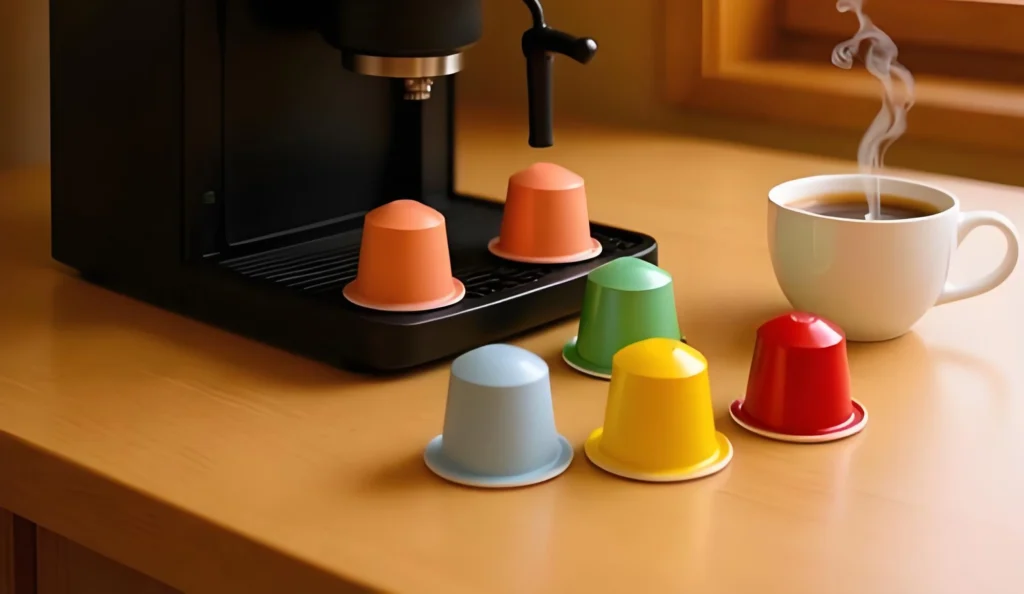
One of the strongest pieces of evidence is not the sample itself.
It is the comparison between the approved sample and the production batch.
For example, the buyer can compare:
| Item | Approved Sample | Production Batch |
|---|---|---|
| Capsule model | Confirmed | Verify |
| Dimensions | Reference | Measure |
| Color | Approved | Compare |
| Surface finish | Approved | Compare |
| Logo | Approved artwork | Inspect |
| Lid | Approved | Verify |
| Packaging | Approved | Verify |
This creates a controlled reference.
It also helps prevent a common purchasing problem:
The sample was good, but the buyer cannot clearly define what “the same product” means when ordering 500,000 pieces later.
The more customized the capsule, the more important this becomes.
For larger or strategically important orders, an on-site factory audit can provide a different level of evidence.
A buyer can observe:
The objective is not to take photographs of every machine.
It is to determine whether the claimed manufacturing process exists in practice.
If an on-site visit is not practical, buyers can request structured production videos, live video calls or independent third-party audits.
These methods do not provide exactly the same level of verification, but they are stronger than relying exclusively on marketing materials.
Communication is sometimes treated as a soft factor.
For supplier qualification, it can actually provide useful evidence.
Pay attention to whether the supplier can answer technical questions clearly.
For example:
Weak answer:
“Don’t worry, our capsules are good quality.”
Stronger answer:
“This model uses the following dimensions and material specification. Here is the inspection method and the relevant sample.”
The second answer is useful because it gives the buyer something that can be checked.
Kervoo currently targets responding to general inquiries within 24 hours, but response speed is only one indicator.
A stronger supplier demonstrates:
Fast response + accurate information + clear documentation + willingness to investigate problems
Instead of saving only a supplier’s brochure, buyers can create a supplier qualification file.
A practical file might contain:
Company Evidence
Product Evidence
Manufacturing Evidence
Quality Evidence
Traceability Evidence
This creates an evidence trail that can be reviewed again six months or one year later.
Before approving an empty aluminum coffee capsule supplier, ask whether you have evidence for each of these areas:
| Area | Evidence to Request |
|---|---|
| Product | Controlled specification |
| Sample | Physical sample |
| Dimensions | Measurement data |
| Color | Approved color reference |
| Printing | Approved artwork/sample |
| Material | Material documentation |
| Compliance | Applicable test reports/certificates |
| Production | Equipment and process evidence |
| Capacity | Actual production capability |
| QC | Inspection procedures/records |
| Traceability | Batch identification |
| Packaging | Carton/packing specification |
| Delivery | Actual lead-time performance |
| Communication | Response and problem-solving record |
Not every supplier needs to provide the same level of documentation.
The appropriate depth depends on order value, customization, destination market, product requirements and supply risk.
But the principle is universal:
Verify the claims that matter most to your business.
A supplier’s sales presentation is useful for starting a conversation.
It should not be the final basis for supplier qualification.
For empty aluminum coffee capsules, the strongest evidence usually comes from things that can be independently checked:
Specification → Physical Sample → Test Documents → Production Evidence → QC → Traceability
A supplier saying that it has:
is only the beginning.
The more useful question is:
“Show me the evidence behind each claim that matters to this project.”
For buyers, this approach reduces the risk of choosing a supplier based primarily on presentation quality.
For manufacturers, it also creates a better long-term relationship because expectations are defined through measurable specifications and documented processes rather than vague promises.
About Kervoo
Kervoo is a manufacturer focused on empty aluminum coffee capsules, serving coffee brands, roasters and capsule-filling businesses.
Kervoo’s current production exceeds 100 million empty aluminum coffee capsules per year, with 35+ stock colors, custom colors and Logo/graphic printing available. Standard stock products are packed at 4,000 pieces per carton, while customized production generally starts from around 20,000 pieces per design.
For buyers evaluating Kervoo, the most meaningful evidence is not simply a capacity figure or product catalog. It is the combination of:
actual product specifications + physical samples + production capability + QC process + customization capability + documented communication.
Authoritative Sources & Further Reading

Coffee Capsule Manufacturing Specialist · Kervoo
Since 2024
A Good Presentation Is Not the Same as Good Evidence. A supplier’s website, catalog and sales presentation are useful starting points. They can tell you

For a coffee brand with only one product, capsule color is mostly a branding decision. Once the product range grows to several SKUs, however, color
An aluminum coffee capsule can leave the factory looking perfectly fine and arrive at the destination with a different problem: a few rims are bent,