























Private Label vs OEM Coffee Capsules: What’s the Practical Difference
A buyer says they need private label coffee capsules. Another asks for OEM. A third uses both terms in the same email to describe exactly
When people hear the term “food-grade aluminum,” they often assume it refers to a special type of metal. In reality, it’s not that simple. There isn’t a single aluminum alloy officially called “food-grade aluminum.” Instead, the term describes aluminum materials that are suitable for food-contact applications when combined with appropriate coatings, manufacturing processes, and regulatory compliance.

For coffee capsules, this matters more than many people realize. Every capsule comes into close contact with roasted coffee throughout filling, storage, transportation, and brewing. Choosing the right material isn’t only about meeting regulations—it also affects manufacturing consistency, product quality, and long-term brand confidence.
One of the biggest misconceptions is that food-grade aluminum depends only on the alloy.
In practice, manufacturers evaluate the complete packaging system. The aluminum itself is important, but so are the food-contact coating, printing inks, forming process, and quality control procedures. A capsule is only considered suitable for food packaging when all of these elements work together and comply with applicable regulations.
For aluminum coffee capsules, 8011 aluminum alloy is one of the most commonly used materials because it offers excellent formability during deep drawing while maintaining the strength needed for commercial production. However, using 8011 aluminum alone does not automatically make a capsule “food-grade.” The finished product must also meet food-contact requirements in the destination market.
Food-contact materials are regulated in most countries because packaging should not negatively affect the food it contains.
In the European Union, food-contact materials are regulated under Regulation (EC) No. 1935/2004. The regulation states that materials intended to come into contact with food should not transfer their constituents into food in quantities that could endanger human health or cause unacceptable changes to food composition or taste.
In the United States, food-contact materials are regulated by the U.S. Food and Drug Administration (FDA). Depending on the application, manufacturers may also need to ensure that coatings and other materials comply with relevant FDA requirements.
For coffee brands exporting internationally, understanding these regulations early helps avoid delays during customer audits, product registration, and customs clearance.
Coffee capsules experience conditions that many other food packages do not.
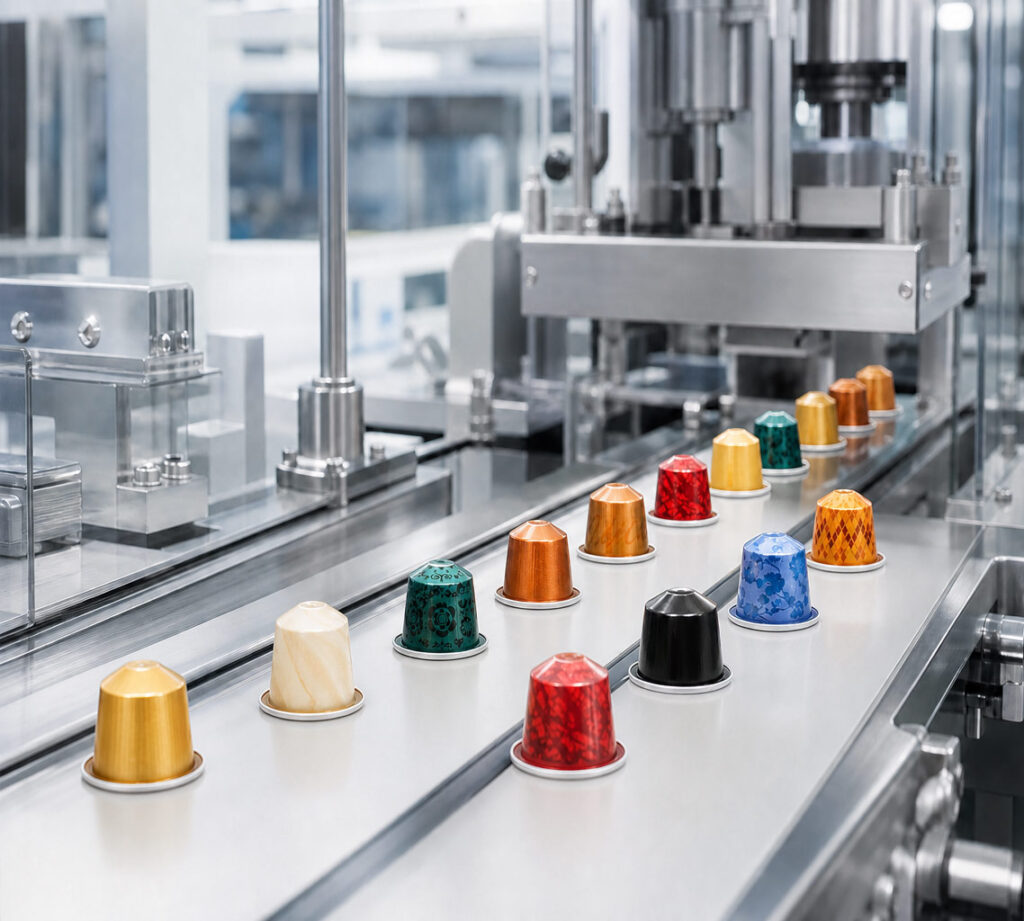
During brewing, espresso capsule systems operate under high temperatures and pressure. For example, many Nespresso® Original machines use pump systems rated at up to 19 bar. Although the actual extraction pressure inside the coffee bed is lower, the capsule itself still needs to maintain structural integrity throughout the brewing process.
This is why manufacturers pay close attention not only to food safety but also to dimensional accuracy, wall thickness, coating performance, and sealing quality. Every stage of production contributes to the final brewing experience.
For coffee brands, choosing food-grade aluminum should not be limited to asking whether a supplier has a certificate.
Instead, it is worth understanding the complete manufacturing process. Which aluminum alloy is used? What type of coating is applied inside the capsule? How is production quality controlled? Can the manufacturer provide documentation for food-contact compliance?
Experienced suppliers should be able to answer these questions clearly and explain how materials, production, and quality control work together.
A certificate is important, but a stable manufacturing system is what helps maintain consistent quality over time.
Meeting food-contact regulations is the starting point, not the finish line.
As consumer expectations continue to rise, coffee brands are paying greater attention to packaging quality, manufacturing consistency, and supplier reliability. Food-grade aluminum is one part of that equation, helping create coffee capsules that are safe, reliable, and suitable for long-term commercial production.
For manufacturers and buyers alike, understanding what “food-grade” really means leads to better sourcing decisions and stronger products.

커피 캡슐 제조 전문가 · Kervoo
2024년부터
A buyer says they need private label coffee capsules. Another asks for OEM. A third uses both terms in the same email to describe exactly
A perfect sample is reassuring. It looks right. The color is right. It drops into the machine smoothly and brews without leaking. Put ten more

훌륭한 프레젠테이션이 반드시 확실한 증거를 의미하는 것은 아닙니다. 공급업체의 웹사이트, 카탈로그, 영업 프레젠테이션은 유용한 출발점이 됩니다. 이를 통해 다음과 같은 정보를 알 수 있습니다.