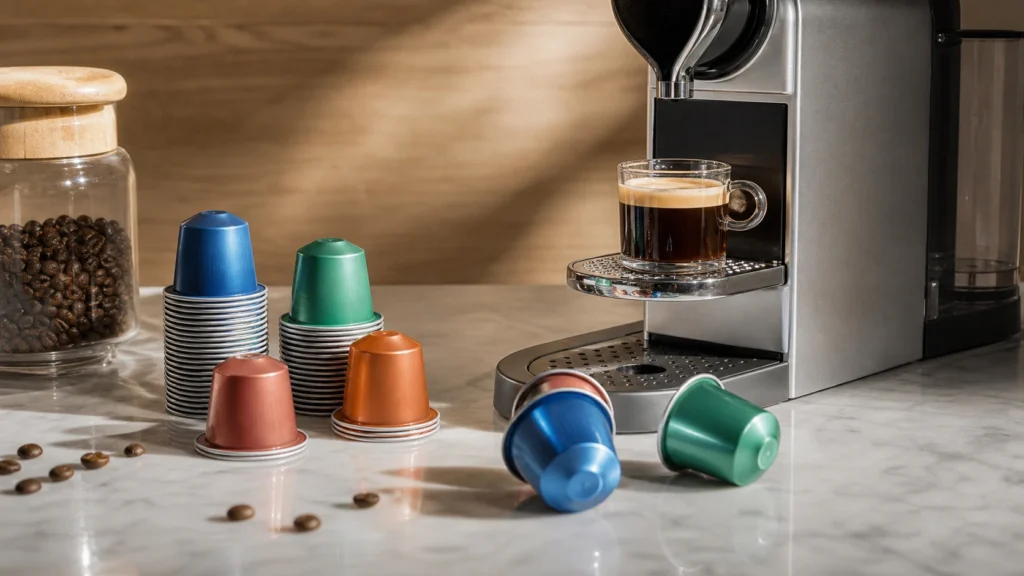
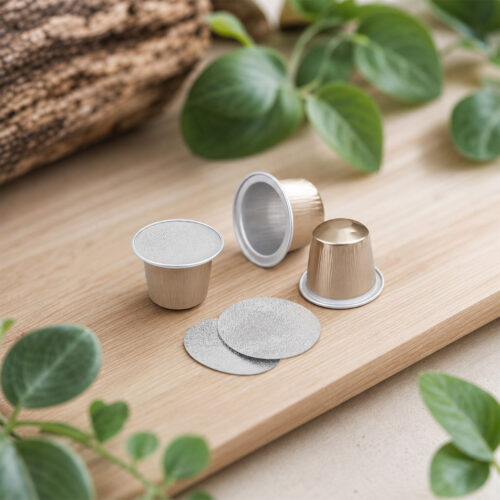
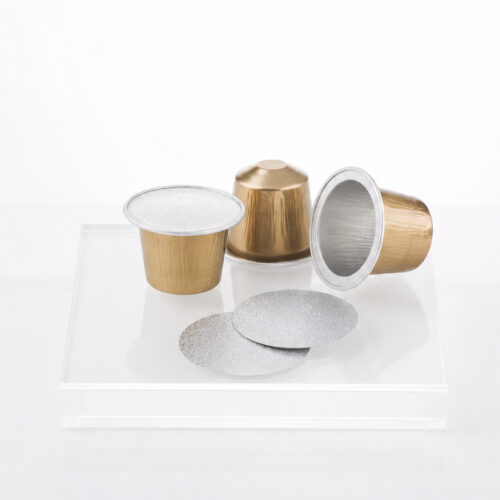
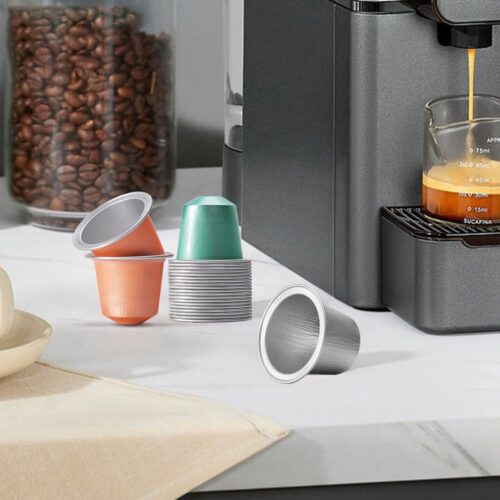
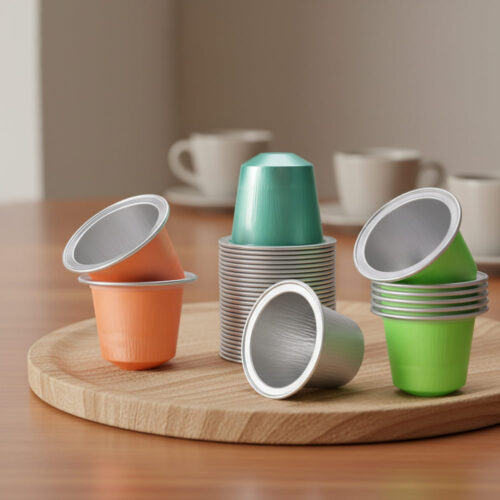
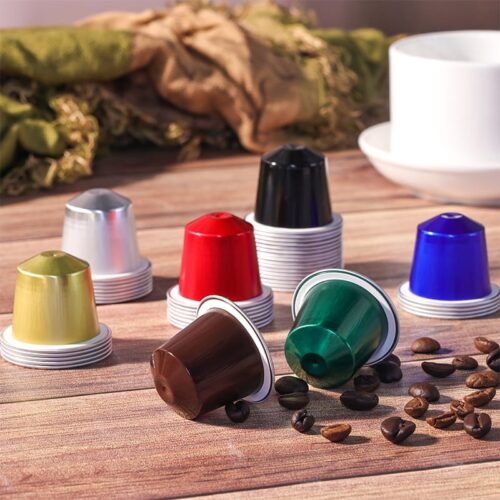
A capsule can fit inside a Nespresso® Original machine and still be a poor match.
Fitting is only the first test.
What happens after the lever closes—how the capsule seats, how it is pierced, whether it seals correctly, how pressure develops, and how consistently the coffee extracts—is where compatibility is really decided.
This distinction matters when you’re sourcing thousands or millions of empty capsules. A dimensional drawing may look correct. A sample may even fit neatly into one machine. Neither tells you the whole story.
For coffee brands and contract fillers, true compatibility is less about one measurement and more about how the entire capsule behaves as part of the brewing system.
That starts with geometry, but it certainly doesn’t end there.
“Compatible” Means More Than “It Fits”
When buyers evaluate a new capsule, the most natural first step is to put it into a coffee machine.
Does it drop into the chamber correctly? Does the lever close normally? Does the capsule eject afterward?
Those are useful checks. They’re just not enough.
During brewing, the capsule becomes a small pressure vessel. The machine introduces hot water, the capsule is pierced, internal pressure develops, and coffee is pushed through the outlet side. Several components have to work together within seconds.
A truly compatible capsule therefore needs to perform through the entire cycle:
It must enter and sit correctly in the brewing chamber.
The machine must close without abnormal resistance.
The capsule must be pierced in the intended areas.
The rim and sealing interface must limit unwanted water bypass.
The lid must open or rupture predictably during extraction.
The capsule should maintain sufficient structural stability under brewing conditions.
It should eject normally after brewing.
A failure at any one of these stages can appear to the consumer as “poor compatibility,” even when the external dimensions look right.
That’s why a simple fit test tells you whether a capsule is approximately the right shape. A brewing test tells you whether it actually works.
Small Dimensional Differences Can Have a Big Effect
Coffee capsules are small products, which makes small dimensional variations surprisingly important.
The overall height and diameter are obvious measurements, but they’re only part of the geometry. Rim dimensions, sidewall profile, bottom shape, material thickness, and the relationship between these features can all influence how a capsule behaves inside the machine.
The Rim Deserves More Attention Than It Usually Gets
The capsule rim looks simple, but it’s one of the more important functional areas.
It interacts with the machine during closure and forms part of the sealing interface during brewing. If its geometry or consistency is wrong, water may follow a path around the capsule rather than moving through the coffee as intended.
That can show up as leakage, weak extraction, inconsistent cup volume, or simply an unusually watery coffee.
The difficult part isn’t making one capsule with the correct dimensions. Modern forming equipment can do that.
The real manufacturing challenge is keeping those dimensions consistent across a long production run.
If you’re purchasing 500,000 capsules, compatibility isn’t demonstrated because ten samples worked well. Those ten samples need to represent the other 499,990.
That’s where process control becomes more important than the nominal dimension printed on a technical drawing.
Piercing Is Part of Compatibility Too
A capsule doesn’t simply sit inside the machine. It has to interact mechanically with it.
During brewing, the machine typically pierces or interfaces with the capsule so that hot water can enter. On the outlet side, pressure and the capsule’s lid or membrane system work together to control how extraction begins.
If the capsule body is too soft, too stiff, poorly formed, or inconsistent from one batch to another, piercing behavior can change.
The lid matters just as much.
A lid that opens too easily may not allow pressure to develop as intended. One that resists opening excessively can produce a very different extraction—or, in some cases, create operational problems.
This is one reason compatibility can’t be evaluated by the empty capsule body alone. The body, lid, sealing system, coffee dose, grind, and filling process eventually become one working package.
Change one variable and the behavior of the others can change with it.
Aluminum Helps With Consistency, but Material Alone Isn’t Enough
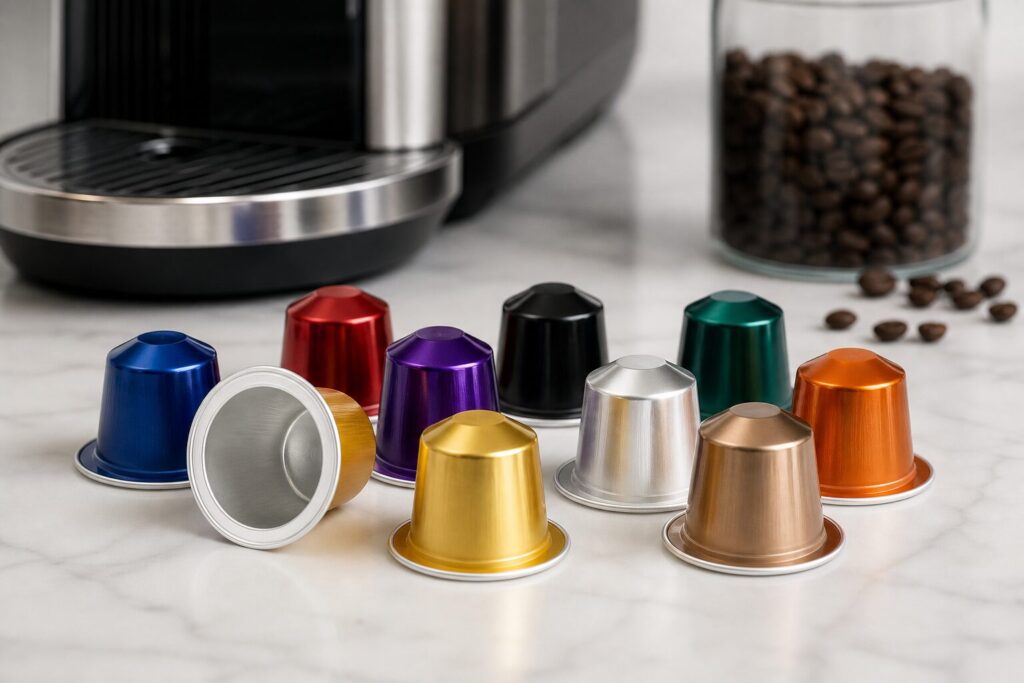
Aluminum is widely used for Nespresso® Original-compatible capsules for good reasons. It offers strong barrier properties, can be formed precisely, and provides useful structural characteristics for capsule applications.
But “aluminum” isn’t itself a guarantee of compatibility.
Two aluminum capsules can look virtually identical and still behave differently because of variations in forming quality, wall distribution, rim geometry, coatings, or overall production control.
This matters when comparing suppliers.
It’s tempting to ask only whether a capsule is aluminum and whether it matches a particular drawing. A more revealing question is how the manufacturer monitors consistency from one production batch to the next.
For commercial filling, consistency is usually what turns compatibility from a successful sample test into a repeatable product.
One Machine Isn’t Enough to Prove Compatibility
A common mistake during product development is to test a few capsules in one coffee machine, get a good result, and consider compatibility confirmed.
It’s a useful start. It isn’t a complete validation.
Nespresso® Original machines have been sold across different markets and product generations, and the installed base includes multiple machine models. Even within the same system, differences in machine condition, age, maintenance, and brewing mechanism can affect how a capsule behaves.
A capsule that performs well in one machine should therefore be tested across a representative selection of machines intended for the target market.
The same applies to sample quantity.
Testing two or three capsules may identify an obvious problem, but it tells you very little about consistency. A proper evaluation should include enough samples to observe repeatability: insertion, lever closure, piercing, leakage, extraction, cup volume, and ejection should all behave consistently across repeated brews.
For brands preparing for commercial launch, compatibility testing should answer two separate questions:
“Can this capsule brew successfully?”
And, more importantly:
“Can it do so repeatedly?”
The second question is where manufacturing quality starts to show.
Not Every Brewing Problem Is a Capsule Problem
This is where troubleshooting can get complicated.
Suppose a test capsule produces a weak cup or extracts faster than expected. It’s easy to conclude that the capsule isn’t compatible. Sometimes that’s exactly the problem. Sometimes the empty capsule is doing everything it should.
Coffee dose matters. So does grind size.
A grind that’s too coarse may allow water to pass through the coffee bed too quickly. Go too fine and resistance can increase considerably. Dose weight, distribution inside the capsule, tamping or compaction, residual oxygen, lid selection, and sealing parameters can also change extraction behavior.
Then there’s the machine itself. Scale buildup, wear, temperature, or inconsistent water delivery can introduce another variable.
This is particularly important for empty-capsule buyers. If you’re sourcing the capsule from one manufacturer and filling it elsewhere, troubleshooting needs to consider both sides of the process.
Before rejecting a capsule because of an extraction problem, try to isolate one variable at a time. Use the same coffee, grind setting, dose, sealing conditions, and machine when comparing capsule samples. Once you establish a baseline, change variables deliberately.
It’s slower than simply brewing one capsule and deciding whether you like the result. It’s also far more useful.
How Should Buyers Test Capsule Samples?
You don’t need a laboratory to carry out a useful first-stage compatibility test.
You do need a consistent method.
Start with the empty capsule. Check whether there is visible deformation around the body or rim and whether samples appear consistent with one another. Then test insertion, closure, and ejection before moving on to filled brewing tests.
Once the capsules are filled and properly sealed, pay attention to the whole brewing cycle rather than taste alone.
A practical evaluation should look at:
Capsule insertion: Does it enter the chamber smoothly?
Machine closure: Does the lever or mechanism close normally?
Piercing: Are the intended areas pierced consistently?
Leakage: Is there unusual water escaping around the capsule?
Extraction: Does flow appear reasonably stable from one brew to another?
Cup volume: Is output broadly repeatable under the same machine setting?
Capsule deformation: What does the capsule look like after brewing?
Ejection: Does the used capsule release normally?
Repeatability: Do these results remain similar across a meaningful number of samples?
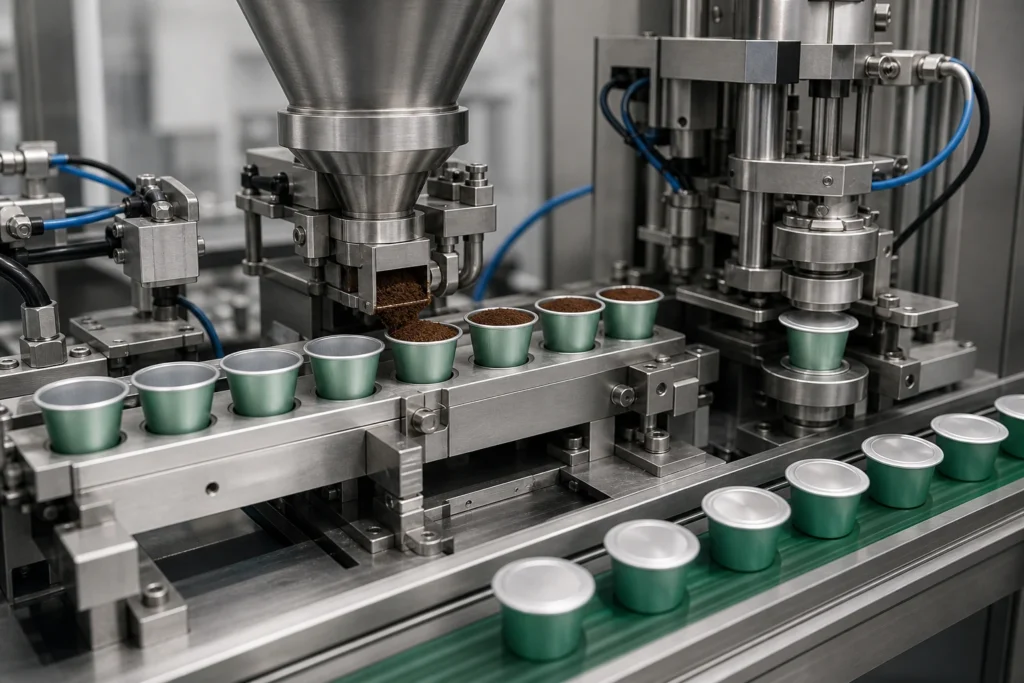
For contract fillers, there’s another step: run the capsule on the intended filling and sealing equipment before approving it for a larger production order. A capsule can brew well and still create difficulties on a filling line if dimensions or handling characteristics aren’t consistent enough.
Record the results. Photos of used capsules, machine model information, sealing settings, dose weight, and notes on any failures can be extremely useful when discussing problems with a manufacturer.
“Capsule leaked” gives an engineer very little to work with.
“Three out of 30 capsules showed water bypass on machine model X, using the same 5.2 g dose and sealing settings” is a much better starting point.
Dalla nostra esperienza nel settore manifatturiero
Compatibility discussions often begin with a drawing.
That’s necessary. We need dimensions, tolerances, materials, and specifications to make a repeatable product.
But the drawing isn’t the final judge. The coffee machine is.
Over the years, we’ve found that the most useful feedback from customers isn’t simply “works” or “doesn’t work.” It’s detailed feedback from controlled testing: which machine was used, how many capsules were tested, what coffee was filled, what happened during extraction, and whether the problem repeated.
That information helps separate a dimensional problem from a sealing problem, a filling issue from a machine issue.
It also explains why we prefer sample testing before a customer moves into a larger OEM order. Fixing a variable during product development is relatively straightforward. Discovering the same issue after filling tens of thousands of capsules is a very different conversation.
Buyer Tip: Ask for More Than a “Compatible” Label
“Compatible with Nespresso® Original machines” is useful product information, but don’t let that be the end of the conversation with a potential supplier.
Ask how compatibility is evaluated.
Ask whether production dimensions are monitored batch by batch. If you’re a filler, discuss your filling and sealing equipment as well as the brewing machine. And before moving into a customized order, request samples and run them under conditions that resemble your actual production setup as closely as possible.
For a new brand, keeping a small reference set of machines can also be useful for ongoing quality checks. Just make sure the models are relevant to the markets where your coffee will actually be sold.
The aim isn’t to create an unnecessarily complicated qualification process.
It’s to find problems while they’re still inexpensive to solve.
What True Compatibility Really Comes Down To
A compatible coffee capsule has to do more than match a drawing.
It needs to move through the machine correctly, seal predictably, respond to piercing as intended, support stable extraction, and repeat that performance across production batches.
Geometry matters. Material matters. The lid and sealing system matter. Coffee and filling parameters matter too.
Most of all, consistency matters.
For brands sourcing empty aluminum capsules, that’s a useful distinction to keep in mind when comparing suppliers. A successful sample is encouraging. A controlled process capable of reproducing that sample at commercial scale is what you’re really buying.
For OEM projects, Kervoo supports sample evaluation before volume production and manufactures food-grade aluminum capsules designed for compatibility with the Nespresso® Original system. If you’re testing a new capsule, sharing your machine models, filling conditions, and test results with the manufacturing team can make technical discussions much more productive.
Does a Nespresso® Original-compatible capsule work with every Nespresso machine?
No. “Nespresso® Original compatible” refers to the Original system and should not be assumed to include other Nespresso® formats such as Vertuo. Buyers should confirm the exact machine system and models relevant to their target market.
Can I judge compatibility from capsule dimensions alone?
No. Dimensions are an important starting point, but brewing performance also depends on rim geometry, structural consistency, piercing behavior, the lid and sealing system, filling parameters, and the condition of the coffee machine.
Why does a compatible capsule sometimes leak?
Leakage can have several causes, including capsule or rim variation, sealing conditions, lid issues, filling parameters, or the coffee machine itself. Controlled testing is usually needed before assigning the cause to one component.
Should empty capsules be tested after filling?
Yes. An empty-capsule fit test is useful, but commercial compatibility should also be evaluated with the intended coffee, dose, grind, lid, and sealing process. Fillers should additionally test performance on their production equipment.
How many capsules should I test before placing a bulk order?
There is no universal number that applies to every project. The test should be large enough to evaluate repeatability rather than a single successful brew, and it should cover representative machine models and actual filling conditions. For larger commercial launches, buyers may choose a more formal validation plan based on their own quality requirements.
Trademark Note
Nespresso® is a registered trademark of Société de Produits Nestlé S.A. Kervoo is not affiliated with, endorsed by, or sponsored by Nestlé or Nespresso. References to Nespresso® are used solely to describe product compatibility.
Il fatto che una capsula perda non significa automaticamente che ne abbiate acquistata una difettosa. A volte il bordo non rientra nei limiti di tolleranza. Altre volte il coperchio non si è chiuso correttamente. Il
Una capsula può entrare in una macchina Nespresso® Original, ma potrebbe comunque non adattarsi bene. L'inserimento è solo il primo test. Cosa succede dopo il
Se state sviluppando un prodotto a base di capsule di caffè, di solito c’è una decisione da prendere prima del previsto: meglio l’alluminio o la plastica? A prima vista, sembra che
Utilizziamo i cookie per il tracciamento pubblicitario. Se decidi di rifiutarli, la normale navigazione sul sito non ne risentirà.
Informativa sulla privacy