














Why Do Coffee Capsules Leak During Brewing? What Buyers Should Check
A leaking capsule doesn’t automatically mean you’ve bought a bad capsule. Sometimes the rim is out of tolerance. Sometimes the lid hasn’t sealed correctly. The

A leaking capsule doesn’t automatically mean you’ve bought a bad capsule.
Sometimes the rim is out of tolerance. Sometimes the lid hasn’t sealed correctly. The coffee may be ground too fine, the capsule may have been slightly deformed during filling, or the brewing machine itself may simply need attention.
From the outside, all of these situations can look remarkably similar: water appears where it shouldn’t, the cup is weaker than expected, or the extraction becomes messy.
That’s what makes leakage frustrating. What looks like one problem can have several completely different causes.
Some of these issues are closely related to capsule compatibility, which involves much more than whether a capsule simply fits inside the machine.
If you’re evaluating empty capsules, running a filling line, or investigating complaints from the market, the most useful thing you can do is resist the temptation to change everything at once.
First, find out where the water is actually coming from.
The word “leaking” isn’t particularly useful from a technical point of view.
A buyer may say, “The capsule leaks,” but that description could refer to several different things.
Water may be bypassing the capsule around the rim rather than flowing through the coffee bed. Liquid may escape through an area where the lid hasn’t sealed completely. The capsule body itself may be visibly damaged. Or water may be appearing inside the machine in a way that has little to do with the capsule.
These shouldn’t be diagnosed in the same way.
Before changing the coffee, sealing temperature, capsule, or machine, brew several samples under the same conditions and observe exactly what happens.
Does leakage begin as soon as the pump starts?
Does it appear around one particular side of the rim?
Is the lid still attached evenly after brewing?
Are all capsules affected, or only one in every 20 or 50?
And does the same problem appear when the exact same capsule is tested in another machine?
Those observations immediately narrow the investigation.
A repeated failure in the same location may suggest something very different from a random failure occurring occasionally across different capsules.
The rim of a coffee capsule doesn’t look particularly complicated. Functionally, though, it’s one of the most important parts of the package.
During brewing, this area participates in the interface between the capsule and the machine. Its diameter, flatness, profile, and dimensional consistency can all influence how well the system controls water flow.
If the rim is deformed or falls outside the intended dimensional range, the machine may not create the expected interface around the capsule.
Water then looks for an easier path.
Instead of being directed through the coffee bed, part of it may travel around the capsule. The result can be visible leakage, an unusually fast flow, inconsistent cup volume, or weak extraction.
This is where manufacturing consistency becomes important.
Producing one capsule with the correct rim geometry isn’t particularly meaningful in commercial production. A manufacturer needs to reproduce that geometry thousands or millions of times.
For a buyer, that means a successful sample test should be treated as the beginning of validation rather than the end.
If 20 capsules perform correctly and the 21st doesn’t, inspect the failed capsule before changing anything else. Compare the rim with a successful sample. Look for deformation, dents, irregularities, or differences introduced during filling and handling.
Sometimes the difference is surprisingly small.
If the capsule geometry looks right, the next place to investigate is usually the lid and sealing process.
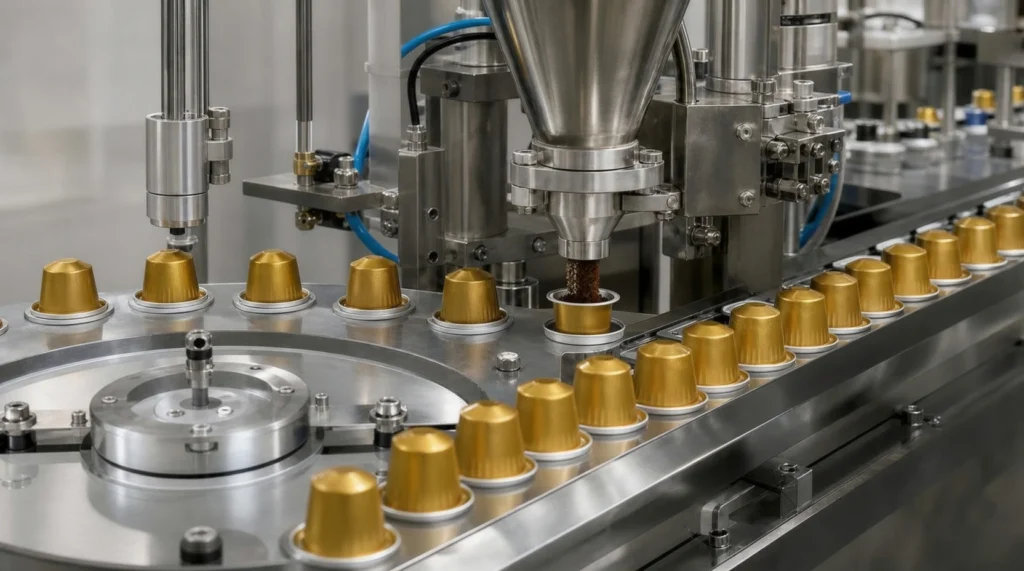
For filled coffee capsules, sealing isn’t simply a matter of applying heat and making the foil stick.
A reliable seal depends on several variables working together. The exact process depends on the lid and sealing system, but key parameters commonly include:
Change one of those variables and the result can change too.
When a seal appears weak, increasing temperature can feel like the obvious solution.
It isn’t always the correct one.
Depending on the sealing system, excessive heat can affect the lid or sealing layer just as an insufficient temperature can prevent a reliable bond from forming. Pressure and dwell time also interact with temperature, so changing one setting without understanding the others can make troubleshooting harder.
Contamination on the sealing surface is another issue worth checking.
Coffee particles or fine powder sitting on the rim can interfere with the seal. This becomes particularly relevant on filling lines where dosing accuracy, vibration, or powder handling allows coffee to reach the sealing area.
If leakage appears only after filling, while the empty capsules consistently pass dimensional and machine-fit tests, the sealing process deserves careful attention before the capsule body is blamed.
Not every apparent compatibility problem begins with packaging.
Coffee itself changes the hydraulic resistance inside the capsule.
A finer grind generally creates more resistance to water flow, while a coarser grind may allow water to travel through the coffee bed more quickly. Dose weight and how the coffee settles inside the capsule add further variables.
Push the system far enough away from the intended filling conditions and pressure behavior changes.
That doesn’t mean there is one universal “correct” grind size or dose for every compatible capsule. Coffee density varies, roast profiles behave differently, and brands target different extraction characteristics.
What matters during troubleshooting is control.
If you’re comparing two capsule samples, don’t change the grind, dose, coffee blend, sealing settings, and machine at the same time. Keep as many variables fixed as possible.
Otherwise, you may end up solving the wrong problem.
A leaking capsule doesn’t automatically mean you’ve bought a bad capsule. Sometimes the rim is out of tolerance. Sometimes the lid hasn’t sealed correctly. The
A capsule can fit inside a Nespresso® Original machine and still be a poor match. Fitting is only the first test. What happens after the
If you’re developing a coffee capsule product, one decision usually comes up earlier than expected: should you choose aluminum or plastic? At first glance, it