























How a Custom Coffee Capsule Moves from Requirement to Production
“Custom coffee capsule” can mean two very different projects. For one buyer, it means taking an existing capsule and changing the color, adding a logo

When buyers ask about the MOQ for OEM coffee capsules, they often expect one simple number.
10,000 pcs?
20,000 pcs?
50,000 pcs?
The problem is that there isn’t one MOQ that applies to every capsule project.
MOQ depends on what you are actually asking the manufacturer to make.
There is a big difference between taking an existing stock capsule and asking a manufacturer to produce a capsule specifically for your brand.
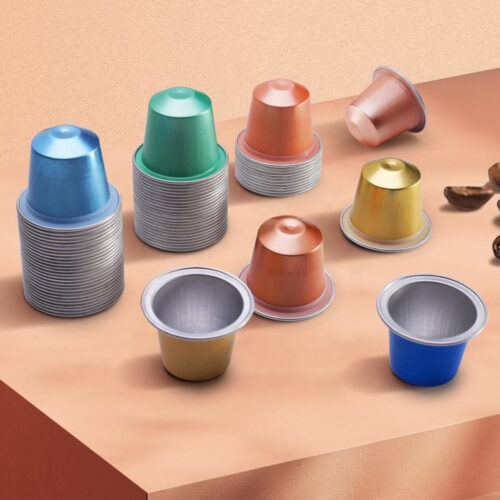
A stock capsule may already have an established size, tooling, production process and color. The manufacturer is essentially allocating existing production capacity to your order.
An OEM project can involve custom colors, surface finishes, printed logos, special dimensions, embossed details, custom lids or other project-specific requirements. Those changes can create additional setup, material and production costs.
So when comparing MOQ, the better question is not simply:
“What is your MOQ?”
It is:
“What is the MOQ for the exact specification I want?”

This distinction is particularly important for small and growing coffee brands.
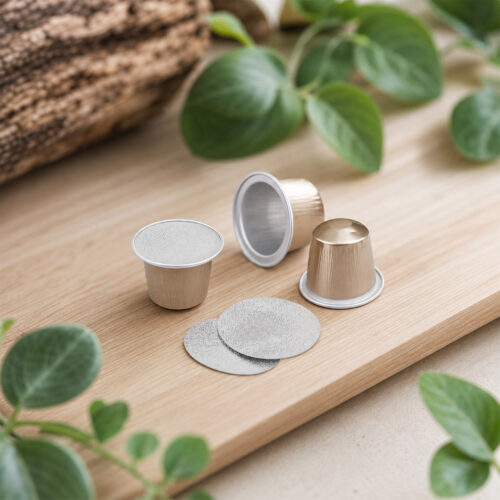
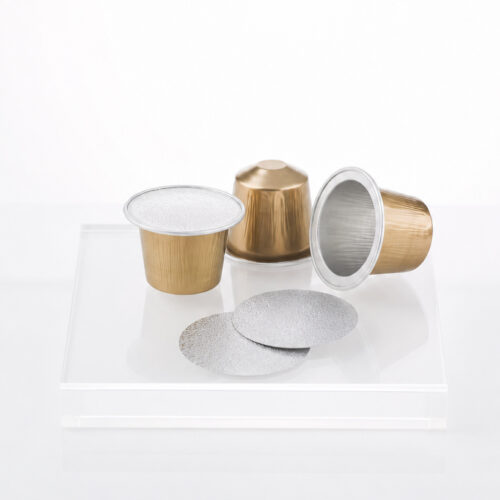
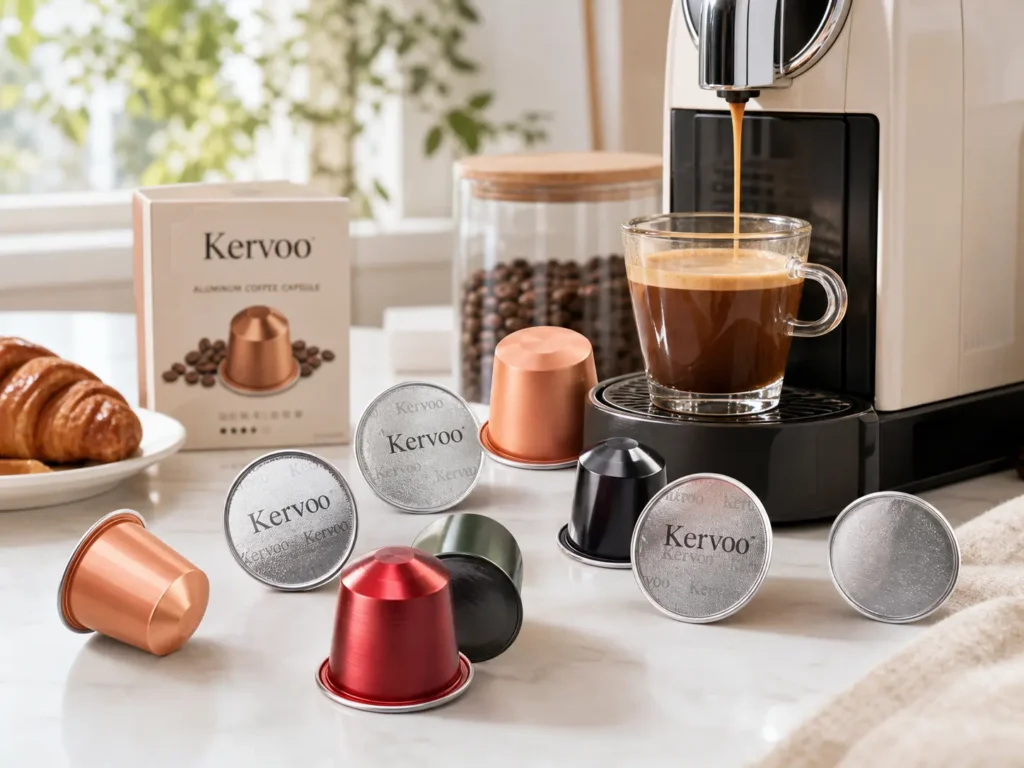
For example, KERVOO can supply stock empty aluminum coffee capsules from 10,000 pcs, subject to current stock and availability. Standard stock capsules are packed at approximately 10,000 pcs per carton.
This type of order is useful when the buyer wants to test the market, start with a smaller quantity or avoid committing to a new custom production run.
Custom capsule projects generally start from around 200,000 pcs per design.
The reason is not simply that a manufacturer wants to sell more units.
A custom order may require dedicated production planning, color preparation, artwork confirmation, material allocation and other production arrangements. When the same specification is produced in a larger quantity, those fixed preparation costs can be spread across more pieces.
That is one of the basic reasons why a custom capsule normally has a higher MOQ than a stock capsule.
Not every customization has the same impact on MOQ.
This is where buyers sometimes get confused.
Changing a capsule from one stock color to another may be relatively straightforward if both colors are already available.
A completely new color is different.
The same applies to printing.
Adding a logo to an established capsule specification does not necessarily have the same production implications as changing the capsule geometry itself.
For an OEM project, buyers should separate customization into several categories:
Appearance: color, metallic effect, matte finish or other surface treatment.
Branding: logo, graphics, printing and lid artwork.
Structure: dimensions, shape, rim or bottom details.
Closure: lid material, printing and sealing requirements.
Packaging: individual boxes, labels, cartons and other retail packaging.
The more project-specific the specification becomes, the less useful a generic MOQ number becomes.

A common misunderstanding is that MOQ means:
“The factory cannot physically produce fewer pieces.”
That is not always the case.
A manufacturer may physically be able to produce a smaller quantity but still set a higher MOQ because the production process has fixed costs.
Think about what happens before the capsules actually come off the line.
Materials need to be prepared.
The production line needs to be scheduled.
Color or printing requirements may need to be confirmed.
Machines may require setup or adjustment.
Quality checks need to be performed.
Packaging materials need to be prepared.
Production records need to be created and controlled.
Whether the order contains 5,000 pieces or 20,000 pieces, some of these activities still need to happen.
The difference is that with a larger order, those preparation costs are distributed across more units.
This is why asking a manufacturer to simply “lower the MOQ” may not be the most productive conversation.
A better approach is to ask:
Which part of the specification is creating the MOQ?
Sometimes changing from a custom color to a stock color makes a bigger difference than negotiating the unit price.
For a new coffee brand, the cheapest unit price is not always the cheapest overall decision.
Suppose one supplier offers a lower price but requires a much larger order.
Another supplier has a slightly higher unit price but allows a smaller first order.
The second option may leave the brand with more cash available for:
Coffee
Roasting
Filling
Packaging
Marketing
Freight
Retail development
Product testing
The difference between the two unit prices needs to be compared with the cost of holding additional inventory.
This is particularly important when demand is still uncertain.
If a brand has not yet established its sales rate, buying more capsules simply to achieve a lower unit price can turn a purchasing saving into an inventory problem.
For a first launch, cash flexibility can sometimes be worth more than the lowest possible piece price.
There is no universal “correct” quantity, but these quantities can represent different stages of a project.
Around 1,000 pcs: useful for a small initial stock order or early market testing when a suitable stock capsule is available.
Around 10,000 pcs: a practical carton-level quantity for standard stock supply and a useful reference point for inventory planning.
Around 200,000 pcs: more appropriate when the project moves into a custom OEM specification, such as a dedicated capsule design or custom color.
These numbers should not be treated as fixed industry rules.
They are procurement reference points based on the specific supply program.
A buyer should still confirm current availability, exact specification, packaging configuration and production schedule before placing an order.
Multiple SKUs can make MOQ planning more complicated.
For example, a brand may want three capsule colors:
Black
Silver
Gold
At first glance, ordering 20,000 pieces sounds straightforward.
But the important question is:
Is the MOQ 200,000 pieces for the whole order, or 200,000 pieces for each design/color?
That distinction can significantly change the size of the purchase.
The same issue applies when different capsule colors, logos, lids or specifications are involved.
Before approving a mixed-SKU order, ask the supplier to provide the MOQ by:
Color
Design
Capsule specification
Lid
Packaging format
This makes the actual purchasing commitment much easier to understand.
Yes, and this can be a sensible route for a new brand.
A brand does not necessarily need to begin with a fully customized capsule.
It can first validate:
Coffee formulation
Capsule compatibility
Filling performance
Customer response
Sales channels
Packaging
Reorder frequency
If the product gains traction, the brand can then move toward a more customized capsule.
For example, a stock aluminum capsule can be used during the initial stage, while the brand identity is built through the lid, outer packaging and other visual elements.
Once demand becomes clearer, the capsule itself can be customized.
This approach separates market validation from manufacturing commitment.
For smaller brands, that can be a useful way to reduce the risk of committing to a large custom order too early.
Before agreeing to an MOQ, don’t just ask for the number.
Ask what the number is based on.
A useful supplier conversation should cover:
Is the MOQ per order, per color or per design?
Does the MOQ include lids?
Is the MOQ based on empty capsules or finished filled products?
Does custom printing change the MOQ?
Does a new capsule dimension require tooling?
Can several stock colors be mixed in one order?
What is the carton quantity?
What is the production lead time?
What happens if the final quantity is slightly above or below the planned amount?
These questions often reveal more about a supplier’s production system than the MOQ number itself.
The right MOQ is not necessarily the lowest MOQ.
It is the MOQ that fits the stage of your business.
A new brand testing its first capsule product may value flexibility.
A growing brand with predictable weekly sales may care more about unit economics and production efficiency.
An established brand with several distribution markets may be better positioned to commit to custom colors, dedicated packaging and larger production runs.
So the same MOQ can be:
Too high for one buyer.
Reasonable for another.
Too low for a third.
The important thing is to match the purchasing quantity to actual demand, production requirements and cash flow.
For OEM coffee capsules, MOQ is not just a supplier number.
It is part of the product and supply-chain design.
What is a typical MOQ for OEM coffee capsules?
There is no single industry-wide MOQ. Stock empty aluminum capsules may be available from around 1,000 pcs, while custom capsule projects commonly start around 200,000 pcs per design, depending on the specification and production requirements.
Is 200,000 pcs a standard OEM MOQ?
Not necessarily. It should be treated as a practical reference rather than a universal industry standard. Color, printing, tooling, capsule dimensions, lids and packaging can all affect the final MOQ.
Can I order only 1,000 aluminum coffee capsules?
If a suitable stock capsule is available, an order can start from around 1,000 pcs. Custom OEM specifications generally require a higher quantity.
How many capsules are packed in one carton?
KERVOO’s standard reference is approximately 10,000 pcs per carton for applicable stock capsule configurations. Buyers should confirm the exact carton configuration for their selected capsule before ordering.

Coffee Capsule Manufacturing Specialist · Kervoo
Since 2024
“Custom coffee capsule” can mean two very different projects. For one buyer, it means taking an existing capsule and changing the color, adding a logo

A trial order arrives. The capsules look good. Production runs. The coffee brews correctly. No major complaints come back. So, is it time to order
When buyers ask about the MOQ for OEM coffee capsules, they often expect one simple number. 10,000 pcs? 20,000 pcs? 50,000 pcs? The problem is