
























Private Label vs OEM Coffee Capsules: What’s the Practical Difference
A buyer says they need private label coffee capsules. Another asks for OEM. A third uses both terms in the same email to describe exactly

Two suppliers quote the same empty aluminum coffee capsule.
One is 8% cheaper.
At first glance, the decision looks easy.
Then you discover the lower quotation is based on a standard color rather than a custom finish. The lid isn’t included. Packaging is different. One supplier quoted EXW, while the other included transport to port. And the quantities aren’t quite the same either.
Suddenly, that 8% difference doesn’t tell you very much.
This happens surprisingly often in B2B sourcing. Buyers compare the number at the bottom of a quotation before confirming whether the two suppliers are actually pricing the same product and the same scope.
For wholesale and bulk aluminum coffee capsule purchases, unit price matters. Of course it does. But it’s only one part of the purchasing cost.

Order volume, capsule specification, customization, lids, packaging, production setup and international freight can all change what the buyer ultimately pays.
The useful question isn’t simply:
“Which supplier has the lowest price per capsule?”
It’s:
“What exactly am I getting for that price?”
Before comparing price, compare specification.
Two capsules can look almost identical in a supplier’s product photograph while differing in ways that matter commercially.
The intended capsule system may differ. Dimensions or construction may differ. Surface finishes may not be the same. One quotation may include a lid while another covers only the empty body.
Even packing quantity can change the comparison.
This is why a useful RFQ should define the product clearly enough that suppliers are quoting against the same requirement.
At minimum, buyers should try to align:
Without this baseline, a price comparison can look precise while being fundamentally wrong.
Three decimal places on a quotation don’t make the underlying comparison accurate.
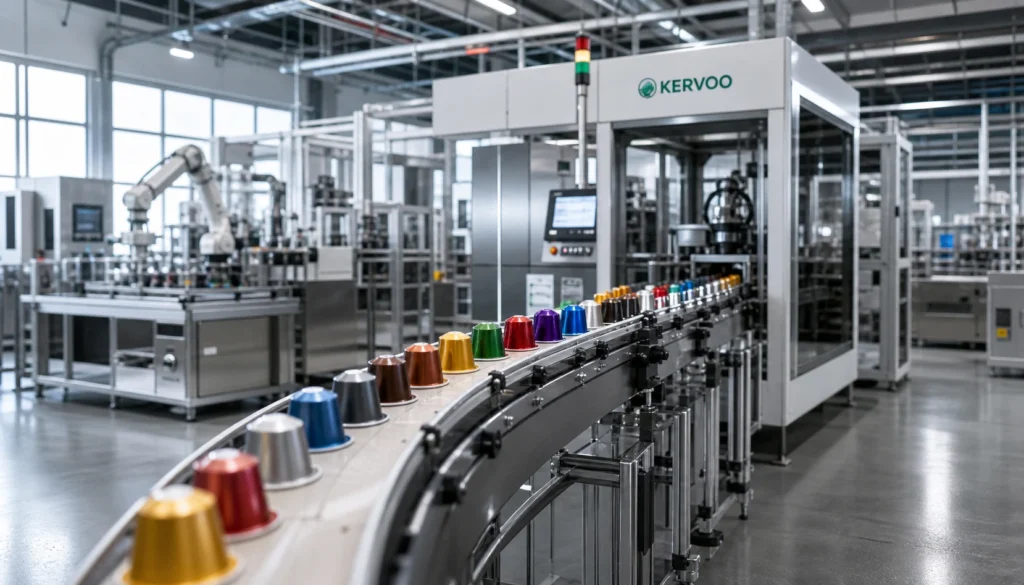
Higher volumes often reduce unit cost, but not because the aluminum suddenly becomes cheaper when you buy more capsules.
Production has fixed or semi-fixed work around every manufacturing run.
Equipment may need to be prepared. Materials need to be organized. Colors or printing need setup. Quality requirements have to be confirmed. Packaging has to be prepared.
Many of these activities don’t increase proportionally with the number of capsules produced.
If a production setup cost is spread across 10,000 capsules, its contribution per capsule will naturally be higher than when the same preparation is spread across 100,000.
This is one reason volume pricing exists.
But there is a point buyers should not miss:
A lower unit price doesn’t automatically mean a lower business cost.
If the larger quantity takes eighteen months to consume, the buyer has exchanged manufacturing savings for inventory.
The better quantity is therefore not necessarily the largest one.
It’s the quantity where production economics and realistic consumption begin to make sense together.
A standard capsule available from inventory and a custom capsule made specifically for one brand shouldn’t be expected to cost the same.
With a stock product, much of the manufacturing setup has already happened. The supplier may be able to fulfill the order directly from existing inventory.
Custom production introduces dedicated work.
That may include:
This doesn’t mean customization is “expensive” by definition.
It means the cost structure is different.
At Kervoo, standard aluminum capsules can start from one carton of 4,000 pieces, subject to stock availability. For customized OEM projects, around 20,000 pieces per design is generally a more practical production starting point.
The difference reflects production reality.
Stock purchasing benefits from work already completed.
Custom production creates work specifically for your product.
“Can you make it blue?”
That’s a simple question.
Commercially, however, color can involve several considerations.
Is the buyer selecting an existing standard color or asking for a specific custom shade?
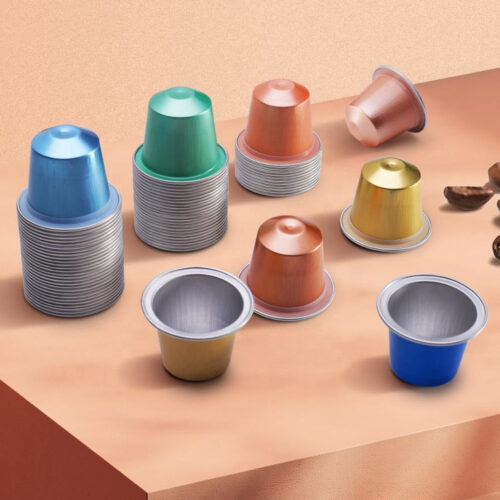
Is the finish metallic or matte?
Does the color need to remain consistent with an approved reference over repeat orders?
Are several colors being produced in the same purchasing cycle?
Each of these choices can affect setup, production planning and minimum practical production quantities.
For a brand, the value of a custom color may be obvious: it helps differentiate SKUs and creates a stronger visual identity.
From a manufacturing perspective, the important point is that a dedicated color may require dedicated preparation.
This is why custom aluminum coffee capsule colors shouldn’t be compared directly with a standard stock color based on unit price alone.
You’re not necessarily buying the same production service.
A logo turns a generic packaging component into brand-specific inventory.
That has value—but also consequences.
Printing requires suitable artwork, production setup and approval. Depending on the design and process, colors and print position need to be established before volume production.
Embossing works differently. It may involve dedicated tooling, depending on where and how the feature is created.
These costs are easier to understand when separated into two categories:
One-time or setup-related cost and recurring per-unit production cost.
A buyer evaluating logo printing on aluminum coffee capsules should therefore ask whether the quotation includes any artwork, tooling, plate, setup or sampling cost separately from the capsule unit price.
This is particularly important when comparing suppliers.
Supplier A may include setup inside the unit price.
Supplier B may list it separately.
The total project cost could be similar even when the capsule prices look quite different.
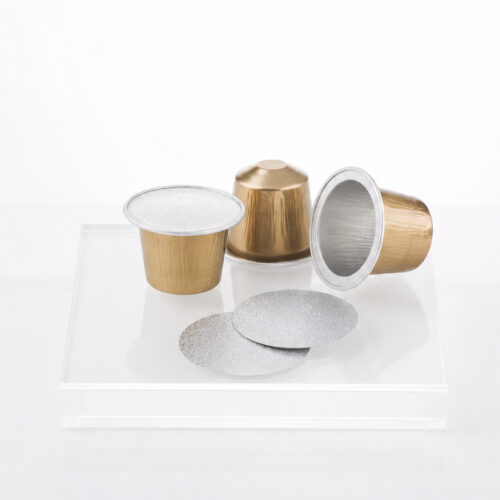
An empty capsule without a lid isn’t yet a complete sealed coffee package.
That sounds obvious, but lid scope is easy to miss when quotations are compared quickly.
One supplier may quote:
capsule only.
Another:
capsule + standard lid.
Another:
capsule + custom printed or embossed lid.
Those aren’t comparable unit prices.
Lid cost itself can vary based on construction, surface finish, printing and customization. More importantly, the lid needs to work with the capsule and the intended sealing process.
A low-cost lid that produces unstable sealing isn’t inexpensive in production.
It creates waste and troubleshooting.
For projects where buyers want the components managed together, combined capsule and lid supply can also simplify specification and procurement, provided the selected combination is validated on the intended filling equipment.
The key is clarity.
Make sure “price per capsule” tells you whether the lid is in or out.
Packaging is often treated simply as the price of the carton.
For empty aluminum capsules, it has another cost:
the cost of failing to protect the product.
Capsules need to arrive with their geometry and rim condition intact. If cheaper packaging increases compression or transport damage, the saving can disappear quickly once unusable products reach the filling line.
At the same time, unnecessarily elaborate packaging adds cost and shipping volume without necessarily improving protection.
Good export packaging therefore balances:
At Kervoo, standard aluminum capsule packing is 4,000 pieces per carton. Exact carton dimensions, gross weight and pallet configuration should be confirmed for the actual order.
Packaging cost should be evaluated against what it is protecting—not just its own purchase price.

A supplier’s factory price is not the same as the buyer’s landed cost.
This becomes particularly important for international sourcing.
Depending on the agreed Incoterm and shipping arrangement, additional costs may include inland transportation, export handling, freight, insurance where applicable, customs-related charges and local delivery.
Taxes and duties depend on the product, destination and applicable rules, so they shouldn’t be estimated from a generic blog article.
The general purchasing principle is much simpler:
Compare quotations at the same point in the supply chain.
EXW versus EXW.
FOB versus FOB.
Or, where possible, compare estimated landed costs based on consistent assumptions.
For lightweight but bulky products such as empty capsules, carton dimensions and space utilization can also influence freight economics significantly.
This makes international forsendelse af kaffekapsler part of the sourcing decision rather than something procurement should think about only after selecting the lowest factory price.
Some purchasing costs never appear on the quotation.
Suppose Supplier A is slightly cheaper, but dimensional inconsistency causes occasional feeding problems.
A line stops.
Operators intervene.
Capsules are rejected.
Production restarts.
If that happens repeatedly, the price difference between suppliers becomes a very small part of the total cost.
The same applies to poor sealing consistency, excessive deformation or packaging damage.
This is why commercial buyers should think about:
Cost per purchased capsule
og
Cost per usable capsule.
They’re not always identical.
For high-volume fillers, reliability can be economically valuable even when it doesn’t appear as a separate line item.
One of the hardest quotation requests to answer well is also one of the shortest:
“Price for 100,000 capsules?”
There’s a number in the question, but almost everything else is missing.
Which capsule?
Which color?
Standard or custom?
Are lids included?
Logo printing?
How many SKUs?
What packaging?
Which destination?
After more than 10 years manufacturing aluminum coffee capsules, we’ve found that quotations become much more useful once these details are clarified.
The goal isn’t to make pricing complicated.
It’s exactly the opposite.
A clearly defined specification makes it possible to understand why a price is what it is—and makes different supplier quotations much easier to compare.
The cheapest quotation shouldn’t need detective work to understand what was left out.
A practical quotation comparison doesn’t need a complicated procurement model.
Put the major elements side by side.
Compare:
Then look at the number.
At that point, the lowest price actually means something.
Until then, it may simply mean the suppliers priced different things.
For empty aluminum coffee capsules, good purchasing isn’t about ignoring price.
It’s about making sure price is the last comparison—not the first one.

Ofte stillede spørgsmål
Why do aluminum coffee capsule prices vary between suppliers?
Quotations may differ because of order volume, capsule specifications, colors and finishes, printing, lids, packaging, production setup and delivery terms. Before comparing price, buyers should first confirm that suppliers are quoting the same scope.
Does ordering more coffee capsules always reduce total cost?
Higher quantities can improve the manufacturing cost per unit, but they also create more inventory. The lowest total business cost depends on consumption, inventory holding, freight and the risk of slow-moving or obsolete stock.
Are lids normally included in the price of empty coffee capsules?
Not always. Suppliers may quote the capsule body separately or as a capsule-and-lid combination. Buyers should confirm explicitly whether the lid is included and whether it is standard or customized.
Why do custom colors and logos cost more than standard capsules?
Customization can introduce dedicated production setup, artwork preparation, printing, embossing, sampling and smaller SKU-specific production runs. The cost impact depends on the actual project.
Should buyers compare EXW prices when importing coffee capsules?
EXW prices can be compared if all other assumptions are aligned, but they don’t represent the buyer’s full landed cost. International freight, export handling, customs-related costs and local delivery may materially change the final sourcing economics.

Specialist i fremstilling af kaffekapsler · Kervoo
Siden 2024
A buyer says they need private label coffee capsules. Another asks for OEM. A third uses both terms in the same email to describe exactly
A perfect sample is reassuring. It looks right. The color is right. It drops into the machine smoothly and brews without leaking. Put ten more

En god præsentation er ikke det samme som gode beviser. En leverandørs hjemmeside, katalog og salgspræsentation er nyttige udgangspunkter. De kan give dig oplysninger om