
























Private Label vs OEM Coffee Capsules: What’s the Practical Difference
A buyer says they need private label coffee capsules. Another asks for OEM. A third uses both terms in the same email to describe exactly

A perfect sample is reassuring.
It looks right. The color is right. It drops into the machine smoothly and brews without leaking. Put ten more beside it and they all perform well.
That’s a good start.
But if your purchase order is for 200,000 capsules, the samples aren’t really the product you’re buying.
The other 199,990 are.
This is where evaluating an fabricante de cápsulas de café vazias de alumínio becomes less about the best sample a factory can produce and more about how tightly the production process can repeat an approved result.
Coffee capsules are small. That makes small variations matter. A change in rim geometry, body shape, forming condition or another functional dimension may be difficult to notice when looking at a handful of samples. On automated filling equipment—or across thousands of brewing cycles—the same variation can become much easier to see.
Commercial manufacturing is therefore a question of repeatability.
Not “Can you make this?”
But “Can you keep making this?”
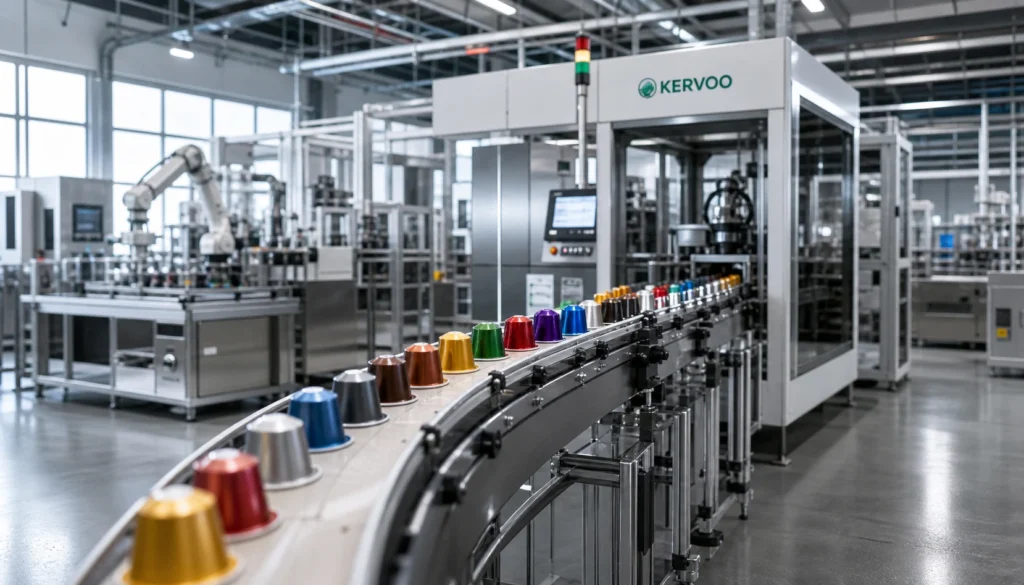
Sample testing is valuable. It should never be dismissed simply because it represents a small quantity.
A physical sample lets buyers examine the capsule, check its appearance, test machine fit, run filling and sealing trials, and evaluate actual brewing performance. Those are all useful steps before committing to commercial production.
What samples cannot demonstrate on their own is long-run process stability.
A supplier may select samples from a small development batch. Production conditions during sampling may also differ from what happens later when orders become larger and the line operates for longer periods.
This doesn’t mean the samples are misleading.
It means they answer a different question.
Sample testing asks:
“Is this design and specification capable of working?”
Production validation asks:
“Can the manufacturing process reproduce that result consistently?”
Both matter.
Confusing one with the other is where procurement risk begins.
A technical drawing may specify the intended dimensions of a coffee capsule.
That’s necessary.
But commercial production doesn’t create one theoretical capsule. It creates a population of real capsules, each subject to some level of manufacturing variation.
The important question is therefore not only:
“What is the dimension?”
É:
“How much does that dimension vary during production, and is that variation acceptable for the intended use?”
This is the difference between a nominal dimension and a tolerance.
For example, knowing the intended diameter of a rim is useful. Knowing the acceptable range around that target—and whether production remains reliably within it—is much more useful for a filling company.
That is why buyers reviewing coffee capsule dimensional specifications should pay particular attention to functional dimensions rather than asking for the tightest possible tolerance everywhere.
Tighter isn’t automatically better.
A tolerance needs to be technically justified, measurable and compatible with the manufacturing process and downstream application.
The goal isn’t to put the smallest number on a drawing.
It’s to control the dimensions that actually affect performance.

If there’s one area of an aluminum coffee capsule that deserves more attention during supplier evaluation, it’s the rim.
It doesn’t look complicated.
But it interacts with several downstream processes.
The rim contributes to the sealing interface. It can affect positioning and handling. In the brewing system, the relationship between the capsule and machine also depends partly on consistent geometry.
A visibly crushed rim is easy to reject.
Subtle variation is harder.
A small change in flatness, shape or geometry may not make the capsule look defective, yet it can contribute to inconsistent sealing or water bypass later.
This is where sample selection can hide a problem unintentionally.
If the ten samples on your desk all came from a stable part of the production run, they may tell you very little about what happened earlier or later in the batch.
The question for production control is therefore not simply whether the rim passed inspection once.
It’s whether the rim remains within the agreed requirements throughout production.
Aluminum capsules are produced through controlled forming operations.
During forming, the material changes shape significantly. The capsule body, sidewall, bottom and rim all need to reach their intended geometry while remaining suitable for later handling and use.
The first hour of production and the tenth hour shouldn’t create functionally different products.
That’s the challenge.
Tool condition, equipment setup, material variation and process conditions can all influence manufacturing results. Good process control is designed to identify meaningful drift before it develops into a larger quality issue.
This is also why experienced buyers shouldn’t evaluate manufacturing capability solely by production speed.
A fast line producing unstable dimensions doesn’t create useful capacity.
Reliable output matters more than theoretical output.

Capacity figures are attractive because they’re easy to compare.
One factory says it can produce one number per day. Another provides a larger one.
But a claimed production number doesn’t tell a buyer how much conforming product can be delivered reliably.
Commercial capacity has several dimensions.
Can the forming equipment maintain the required product characteristics at production speed?
Can quality inspection keep pace?
Can finishing, printing and packaging support the same volume?
Can the factory repeat that output when several customer orders overlap?
And can it do so without allowing quality variation to grow?
This is why capacidade de produção de cápsulas de café is more useful when evaluated together with process stability rather than treated as a headline number.
For a buyer, effective capacity is not simply how many capsules a machine can theoretically make.
It’s how many acceptable capsules the manufacturing system can reliably deliver.
Consistency within one production run is important.
Consistency between production runs can be even more revealing.
Imagine a coffee brand approves a metallic green capsule in January.
The next order arrives in April.
Then another in September.
The customer reasonably expects all three deliveries to belong to the same product—not three slightly different interpretations of it.
Dimensions should remain aligned with the approved specification. Functional behavior should remain stable. Where appearance is important, the agreed color or finish should also be managed consistently.
This is where documentation begins to matter as much as machinery.
Which specification is current?
Which artwork was approved?
Which reference defines the finish?
Have any materials or processes changed?
Repeat orders expose weak version control quickly because the factory can no longer rely on memory from a recent development project.
The approved product has to become reproducible information.
There is an important difference between finding a defective capsule and controlling manufacturing consistency.
Defect detection asks:
“Is this particular capsule acceptable?”
Process control asks:
“Is production starting to move away from where it should be?”
The second question can prevent far more problems.
If a functional dimension begins trending toward the edge of an agreed range, waiting until products actually fall outside specification loses useful information.
Similarly, if a surface finish begins changing gradually, comparing only individual capsules against a broad pass/fail criterion may not reveal the trend early enough.
A meaningful processo de controlo de qualidade das cápsulas de café should therefore help the manufacturer understand the production process, not merely sort finished capsules.
For buyers, this is why asking “Do you inspect your products?” isn’t enough.
Almost every supplier will say yes.
Ask what is monitored during production and what happens when the process begins to vary.
That answer tends to be much more informative.
When sample testing goes well, buyers understandably want to move forward.
Before doing so, a few questions can reveal how well the sample is connected to future production.
What specification will mass production follow?
Which dimensions are considered functionally important?
How are those dimensions checked during production?
How is the approved color or finish referenced for repeat orders?
How are production lots identified?
What happens if a measurement moves outside the agreed requirement?
Will changes to relevant materials or processes be communicated?
None of these questions is particularly complicated.

The answers simply show whether the approved sample exists as part of a controlled production system—or only as a nice sample sitting on a desk.
Buyers naturally spend a lot of attention on samples because samples are tangible.
You can hold them, compare colors, measure them and brew with them.
Production consistency is harder to see.
It shows up later—in whether filling runs smoothly, whether repeat orders look the same, whether occasional failures remain occasional, and whether the manufacturer can trace an issue when something does change.
After more than 10 years of aluminum coffee capsule manufacturing, we’ve found that the most useful customer discussions tend to shift over time.
At first:
“Can you make this?”
Later:
“Can you make this consistently?”
And eventually:
“Can you keep supplying it consistently?”
Those are three different questions.
A reliable manufacturing relationship needs to answer all three.
None of this means buyers should care less about samples.
Quite the opposite.
A good sample establishes the target.
The mistake is assuming the target will reproduce itself.
Commercial manufacturing needs a process capable of taking that approved specification and recreating it across the rest of the order, the next batch and the next repeat order.
That’s why manufacturing consistency matters more than perfection in one isolated sample.
A sample can win approval.
Consistency keeps the product approved.
For buyers comparing suppliers, that distinction shifts attention away from who can present the most impressive handful of capsules and toward something much more valuable:
who can reliably make the product you actually intend to buy.
Perguntas frequentes
Does a perfect coffee capsule sample guarantee good mass production?
No. A successful sample confirms that the product can perform under the tested conditions. Mass production also requires the manufacturing process to reproduce the approved dimensions, appearance and functional characteristics consistently across a much larger quantity.
What’s the difference between a nominal dimension and a tolerance?
A nominal dimension is the target value. A tolerance defines the acceptable variation around that target. For commercial production, both need to be considered together with the functional requirements of the capsule.
Why is rim consistency important for aluminum coffee capsules?
The rim participates in sealing and can influence downstream handling and brewing behavior. Variation in rim geometry or condition may contribute to inconsistent performance even when the capsule looks acceptable.
How can buyers evaluate batch-to-batch consistency?
Start with a clearly approved specification and reference, then compare relevant dimensions, appearance and functional performance across production lots and repeat orders. Version control and traceability also help distinguish intended changes from uncontrolled variation.
Does higher production capacity mean better manufacturing consistency?
Not necessarily. Capacity and consistency are related but separate issues. A useful capacity assessment considers whether required product characteristics, quality control and packaging can remain stable at the intended production volume.

Especialista em Fabrico de Cápsulas de Café · Kervoo
Desde 2024
A buyer says they need private label coffee capsules. Another asks for OEM. A third uses both terms in the same email to describe exactly
A perfect sample is reassuring. It looks right. The color is right. It drops into the machine smoothly and brews without leaking. Put ten more

Uma boa apresentação não é o mesmo que boas provas. O site, o catálogo e a apresentação de vendas de um fornecedor são pontos de partida úteis. Podem dar-lhe informações sobre