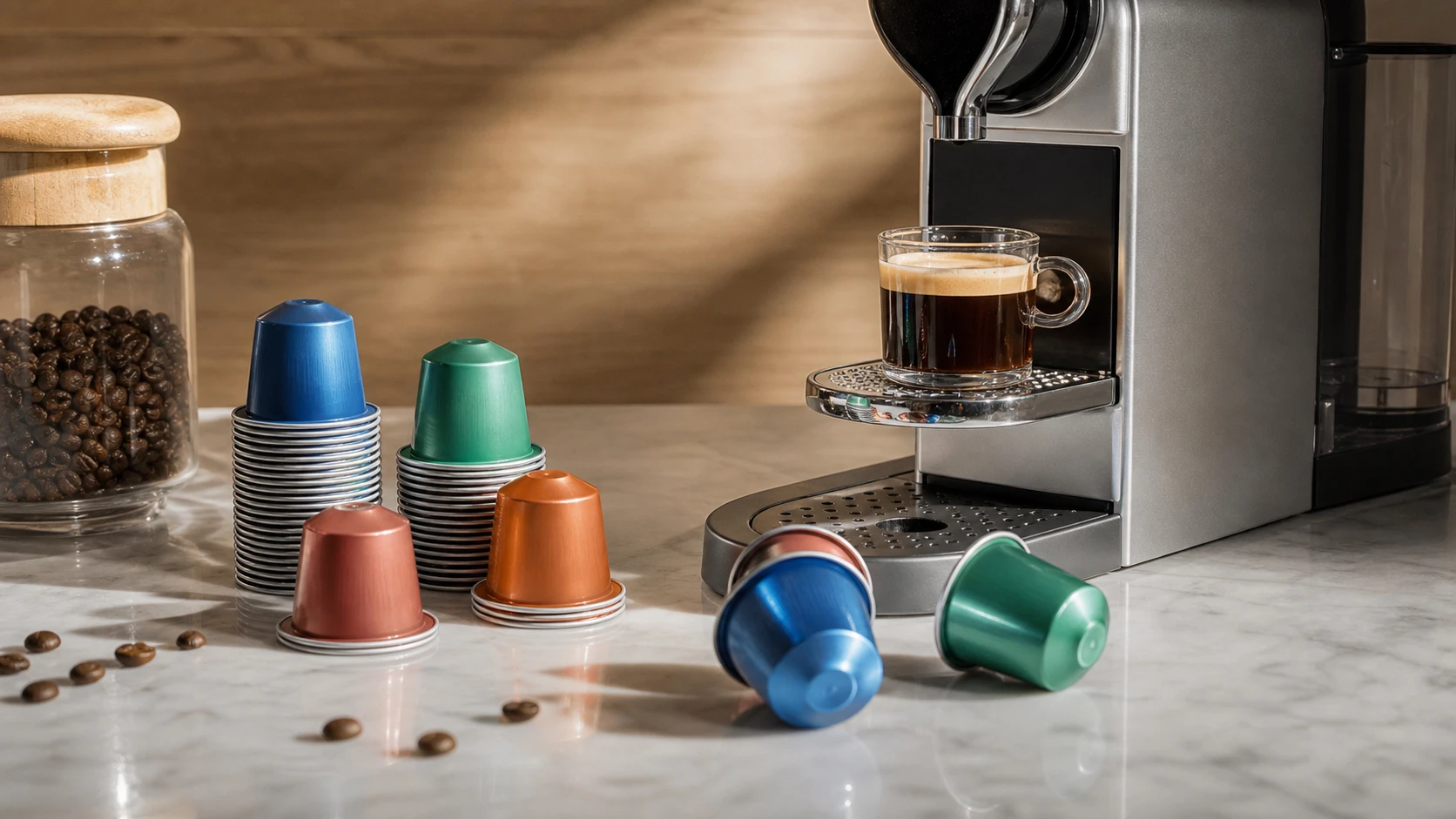
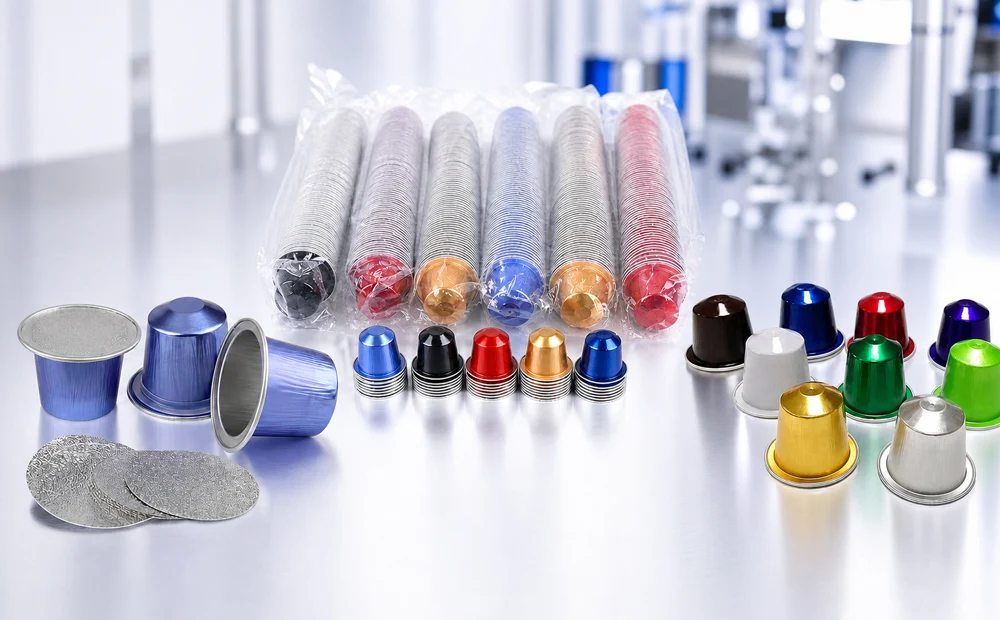
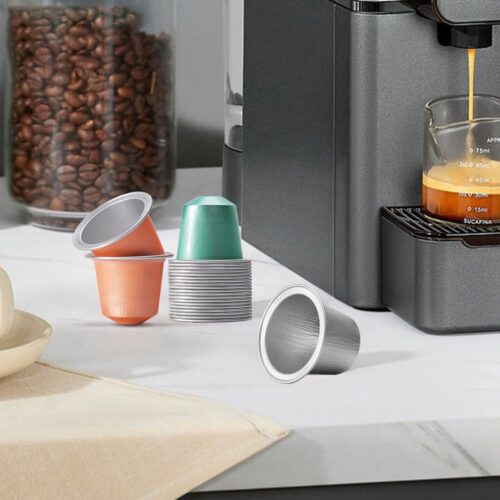
An aluminum coffee capsule looks simple until you have to specify one for commercial production.
Then the questions change.
What is actually in contact with the coffee? Which lid will be used? Will the capsule run consistently on filling equipment? How does the finished package protect roasted coffee? And if 20 samples work well today, what gives you confidence that the same capsule will behave consistently across a much larger production run?
For a professional buyer, those questions are far more useful than simply asking whether a capsule is made from aluminum.
A commercial coffee capsule is better understood as a small packaging system. The formed body, internal surface, rim, lid, seal, filling process and manufacturing consistency all contribute to how the finished product performs.
Aluminum brings valuable properties to that system. It doesn’t do the entire job by itself.
An Aluminum Capsule Is More Than a Formed Metal Cup
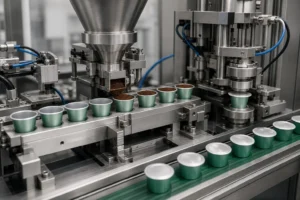
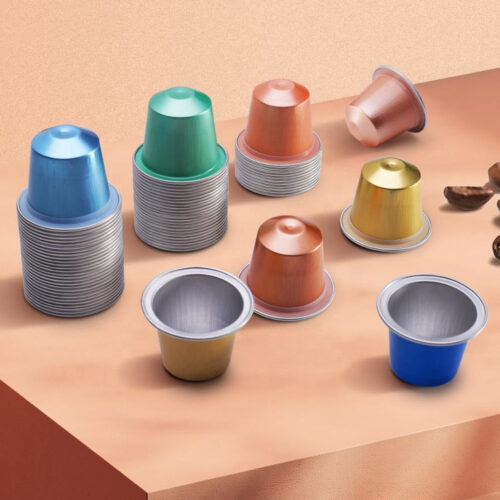
The aluminum body gives the capsule its basic geometry and much of its structural behavior. It has to remain suitable for handling, nesting, transport, filling and sealing before it ever reaches a coffee machine.
That already asks quite a lot from a very small package.
But the body isn’t the complete product.
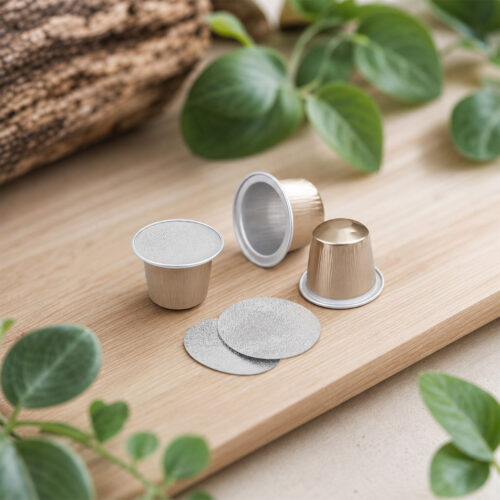
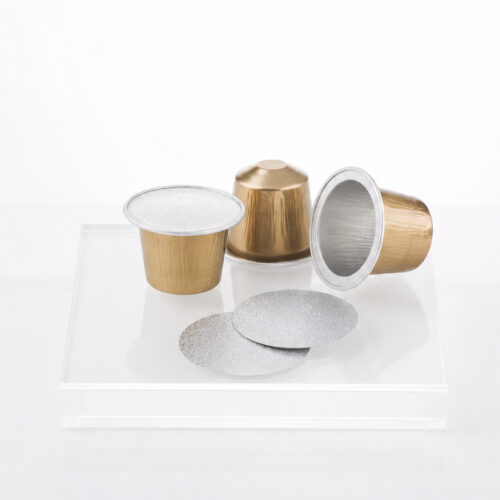
The internal surface matters. So does the rim. A lid has to work with that rim under the intended sealing conditions, and the completed package has to remain sufficiently intact through storage and distribution.
This is particularly relevant when buying empty aluminum coffee capsules with lids. Treating the capsule body and lid as unrelated components may look convenient during purchasing, but they eventually have to operate as one package.
The same principle applies farther downstream. A capsule can look perfectly acceptable on a desk yet behave differently when it is fed through automated equipment or brewed under pressure.
That is where specifications begin to turn into actual performance.
Food Contact Needs More Precision Than “Food-Grade”
“Food-grade aluminum” is widely used in product descriptions. It’s understandable language, but it can be too vague for a commercial specification.
There isn’t a single worldwide grade called “food-grade aluminum” that automatically establishes suitability for every food-contact application or destination market.
In the European Union, Regulation (EC) No 1935/2004 establishes the general framework for materials and articles intended to come into contact with food. The United States uses a different regulatory framework for food-contact substances administered by the U.S. Food and Drug Administration.
For an international buyer, the difference isn’t academic. It affects what should be evaluated and what documentation may be relevant.
The aluminum itself is also only part of the food-contact system. Where a capsule uses an internal coating or lacquer, that finished surface deserves attention too.
A useful supplier question is therefore not simply:
“Is this food-grade?”
It is:
“What is the intended food-contact use of this finished capsule, and what supporting documentation is available for our target market?”
Buyers working through these questions can look more closely at food-contact aluminum coffee capsules rather than relying on a broad material claim.
Why Aluminum Works Well as a Barrier Material
Roasted coffee isn’t static after packaging.
Many of the compounds responsible for its aroma are volatile, and coffee continues to undergo chemical changes during storage. Oxygen plays an important role in staling, while moisture, light and temperature can also affect product stability.
Packaging can’t stop time. Its job is to slow unwanted change.
Aluminum is useful here because intact foil provides an excellent barrier to light, gases and water vapor. This barrier function is one of the reasons aluminum has a long history in demanding food and beverage packaging.
There is a qualification that matters, though.
The barrier performance of aluminum as a material isn’t automatically the barrier performance of a finished coffee capsule.
Once the package is assembled, there is also a lid and a sealed interface. The product then goes through filling, handling, packing and distribution. Damage or an inadequate seal can compromise a package even when the underlying material has excellent barrier properties.
A simple analogy works well: a high-performance wall isn’t much help if the door doesn’t close properly.
For that reason, commercial buyers should evaluate the finished packaging system, not the aluminum body in isolation.
Barrier Performance Is Not a Shelf-Life Number
This distinction is important because shelf-life claims can become overly simple.
Using aluminum does not, by itself, prove that a particular coffee will maintain its intended sensory quality for 12, 18 or 24 months.
The coffee matters. Roast profile matters. Residual oxygen after filling matters. The lid and seal matter. Storage conditions matter.
If nitrogen flushing is part of the filling process, that becomes another variable.
For this reason, a commercial shelf-life claim should ideally be supported by evaluation of the actual finished product under conditions relevant to its intended storage and distribution.
Material properties are part of that evidence.
They aren’t a substitute for it.
This is also why two coffee brands using apparently similar aluminum capsules can legitimately establish different shelf-life targets for their finished products.
Sealing Is Where Material Performance Becomes Package Performance
For a filled capsule, the lid and seal close the barrier system.
That makes sealing a functional requirement rather than a secondary packaging detail.
Heat-sealing performance depends on the materials involved and the process being used. Temperature matters, but it isn’t the only variable. Pressure, dwell time, equipment alignment, sealing-layer characteristics and cleanliness of the rim can all influence the result.
This is particularly relevant to contract fillers, where even a good capsule-lid combination still has to be set up correctly on the intended equipment.
If fine coffee particles contaminate the rim, the outcome may change. If the lid construction changes, the previous sealing parameters may not necessarily remain optimal.
When troubleshooting, “increase the temperature” isn’t a complete technical strategy.
Controlling variables is.
Commercial Quality Comes Down to Repeatability
A well-made sample is encouraging. It is not the same thing as stable mass production.
That difference becomes visible when production volume increases.
Small changes in rim geometry, overall dimensions, forming or physical condition may affect filling, sealing or brewing performance. Some variations are obvious during inspection. Others only become apparent after capsules run through equipment repeatedly.
This is why coffee capsule quality control is more meaningful when it focuses on the production process rather than final appearance alone.
A professional buyer should be interested in questions such as:
What characteristics are monitored during production?
How is variation identified?
What happens when a product falls outside an agreed requirement?
How are repeat orders kept aligned with the approved specification?
There is a useful way to think about this.
A sample tells you whether a manufacturer can make the product.
Repeatability tells you whether they can manufacture it commercially.
The Buyer Still Needs to Define the Application
Even a technically good capsule can be the wrong capsule for a particular project.
That is why useful sourcing normally begins with the application.
Which brewing system will be used?
Will the capsules be filled internally or by a contract filler?
Which lid is planned?
Is the project using a standard finish or developing a custom appearance?
How many SKUs are involved?
Where will the finished product be sold?
And what kind of annual volume is realistically expected?
These details influence technical requirements and commercial decisions at the same time.
They also make quotations more useful. Comparing a stock product with a fully customized production run purely on unit price doesn’t tell a buyer very much.
If the project is still at an early stage, it is often better to resolve compatibility, filling and sealing questions first. Color, printing and packaging can come afterward.
Function before decoration is usually the more efficient order.
Z naszego doświadczenia w produkcji
The best technical discussions usually begin when the buyer explains how the capsule will be used.
For a filler, that might mean sharing the equipment and sealing setup.
For a brand, it might mean explaining the target market, expected annual demand and whether the first stage is testing or full customization.
For a roaster, coffee formulation and intended extraction may be part of the discussion.
These details reduce assumptions before production starts.
At Kervoo, samples are available for product evaluation. Standard aluminum coffee capsules can start from one carton of 4,000 pieces, subject to stock availability. For customized OEM projects, around 20,000 pieces per design is generally a more practical production starting point.
Those numbers are useful for commercial planning.
But they come after the technical question: is the capsule actually right for the application?
A small order of the wrong product is still the wrong product.
What Matters Most Before Commercial Production
For buyers, the practical lesson is fairly simple.
Don’t evaluate an aluminum coffee capsule as a piece of metal.
Evaluate it as a finished packaging system that eventually has to work with coffee, a lid, sealing equipment, filling conditions, a brewing machine and a real supply chain.
Aluminum provides strong fundamentals, particularly in barrier performance. The commercial result comes from how well the rest of the system is designed and controlled around it.
Before moving into volume production, define the application, verify relevant food-contact requirements, test the capsule and lid under realistic conditions, and look for repeatability rather than one impressive sample.
The next step is then much clearer.
If you need to explore manufacturing, material, sealing and quality requirements together, the Aluminum Coffee Capsule Solutions hub brings those commercial paths into one place.
Najczęściej zadawane pytania
Why is aluminum widely used for coffee capsules?
One important reason is its excellent barrier performance against light, gases and water vapor. For a finished capsule, however, the lid, seal, filling process and package integrity also affect overall protection.
Does an aluminum capsule guarantee a specific shelf life?
No. Coffee characteristics, residual oxygen, sealing, storage conditions and other variables also affect shelf life. Commercial claims should ideally be supported by testing of the actual finished product.
What should buyers check about food contact?
Buyers should consider the finished food-contact system, intended use, destination market and relevant supporting documentation rather than relying only on the phrase “food-grade aluminum.”
Why do the capsule and lid need to be tested together?
Because the lid, sealing layer, capsule rim and sealing process function together. A good capsule and a good lid do not automatically create a reliable package unless the combination has been validated.
What matters most when evaluating capsule quality?
Repeatability. Appearance and dimensions matter, but professional buyers should also consider whether the approved characteristics can be maintained across commercial production and repeat orders.
Specjalista ds. produkcji kapsułek do kawy · Kervoo
Od 2024 roku
Alex Chen zajmuje się pustymi aluminiowymi kapsułkami do kawy, procesami produkcyjnymi, kontrolą jakości, dostosowywaniem produktów na zamówienie (OEM) oraz globalnym zaopatrzeniem. Dzieli się praktycznymi spostrzeżeniami z markami kawy, palarniami, importerami oraz firmami zajmującymi się napełnianiem kapsułek.
Pierwsze zamówienie na kapsułki z kawą zazwyczaj nie stanowi prawdziwego sprawdzianu dla łańcucha dostaw. Prawdziwym sprawdzianem jest piąte zamówienie. Do tego czasu pierwsze próbki już dawno
Kapsułka, która na biurku wygląda idealnie, może zachowywać się zupełnie inaczej, gdy trafi na linię rozlewniczą. Dlatego zatwierdzanie aluminiowych kapsułek do kawy
Aluminiowa kapsułka na kawę wydaje się prosta, dopóki nie trzeba zaprojektować jej do produkcji na skalę przemysłową. Wtedy pojawiają się inne pytania. Co właściwie styka się z